
Compliance can eliminate an AI agent integration platform before its features matter. The platform may support every API you need, but still fail a security review because of where customer data runs, how credentials are handled, or what gets retained after a tool call.
This post ranks six agent integration platforms on their compliance layer: certifications, HIPAA BAAs, data residency, data retention, and auditability of tool calls. We checked each vendor’s claims against its own documentation in August 2026. For a broader feature comparison, see best AI agent integration platforms.
TL;DR
All six platforms compared here claim SOC 2 Type II. The differences start to show when you look beyond the certification. Where can you run the platform? What does it store after a tool call? Does it support the BAA, data residency, and audit trail your security team requires?
- Nango: Best overall for customer-facing agent integrations with compliance requirements. It connects agents to 1,000+ APIs and supports SOC 2 Type II, GDPR, and HIPAA with a business associate agreements (BAA). For stricter residency requirements, Bring your own cloud (BYOC) runs Nango in your own cloud account and region. The runtime is also open source, so teams can inspect the code that handles credentials and executes integrations.
- Workato: Best suited to enterprises that need a wide range of certifications and centralized controls. Its automation recipes can be exposed to agents through MCP. Workato is cloud-only, however, and integrations are built in its visual recipe editor rather than maintained as code in your repository.
- Merge: A good fit when its unified API covers the integrations you need. It supports SOC 2 Type II, ISO 27001, and HIPAA with a published BAA, with hosting available in the US, EU, and APAC. Merge cannot be self-hosted, and its normalized data model means you may not get every provider-specific field or capability.
Paragon, Arcade, and Composio cover more specific use cases, which we look at below.
What are AI agent integration platforms?
An AI agent integration platform connects an agent to external APIs. It handles authentication, stores credentials, defines the tools an agent can call, executes API requests with the right user’s credentials, and logs what happened.
These responsibilities matter for AI agent compliance. Credentials need to be encrypted and kept out of the model. The execution layer determines how credentials are injected into API requests. Logs provide the audit trail for showing which tool an agent called, for which user, and what happened.
This puts the integration platform in scope for security and compliance reviews. It holds customer credentials and uses them to access external systems on the customer’s behalf.
What makes an agent integration platform compliant?
Between January and August 2026 we talked to more than 300 engineering teams evaluating integration platforms, and the compliance questions repeated. The criteria below come from those calls, not from a framework. The broader evaluation checklist is in what engineering teams look for in API integration platforms.
| Criterion | What to verify |
|---|---|
| Certifications | SOC 2 Type II, ISO 27001, and whether the report is public or shared under non-disclosure agreement (NDA) |
| HIPAA | Whether the vendor signs a business associate agreement, on which plan, and at what cost |
| Data residency | Which regions the managed cloud runs in, and whether US-only is the only option |
| Deployment | Self-hosting, virtual private cloud (VPC), and BYOC, and whether they run at feature parity |
| Credential handling | Encryption at rest, key custody, server-side injection, rotation, per-connection revocation |
| Data retention | What the platform stores from tool calls, for how long, and whether you can turn it off |
| Auditability | Request-level records of every tool execution, with SIEM or OpenTelemetry export |
| Access control | Role-based access control (RBAC), single sign-on (SSO), Security Assertion Markup Language (SAML), permission-scoped keys, and per-user checks on tool calls |
| Procurement readiness | Data processing agreement (DPA), subprocessor list, penetration test summary, trust center, and service-level agreements (SLAs) |
| Track record | Public incident history and how the vendor handled the cleanup |
Three of these separate vendors in practice.
Residency is a pass or fail filter. EU customer data cannot flow through US-only infrastructure without a legal transfer pathway under GDPR Chapter V. Teams told us repeatedly that a US-only cloud ended the evaluation before any feature discussion, no matter how good the catalog was.
Retention defaults decide how much data you inherit. Several platforms store full request and response payloads from every tool call unless you configure otherwise. If your agent reads patient records or payroll data, that payload store is part of your compliance scope on a retention window the vendor picked.
Auditability requires tool-execution records. Check that the platform records which user, through which connection, ran which tool, against which API, and with what outcome. Several platforms log administrative events in the dashboard and stop there, which leaves nothing to answer an audit question about agent activity.
For the agentic AI security architecture behind these controls, rather than the paperwork on top of it, see best API integration platforms for secure AI agent tool calling.
The best AI agent integration platforms for compliance in 2026
1. Nango
Overview
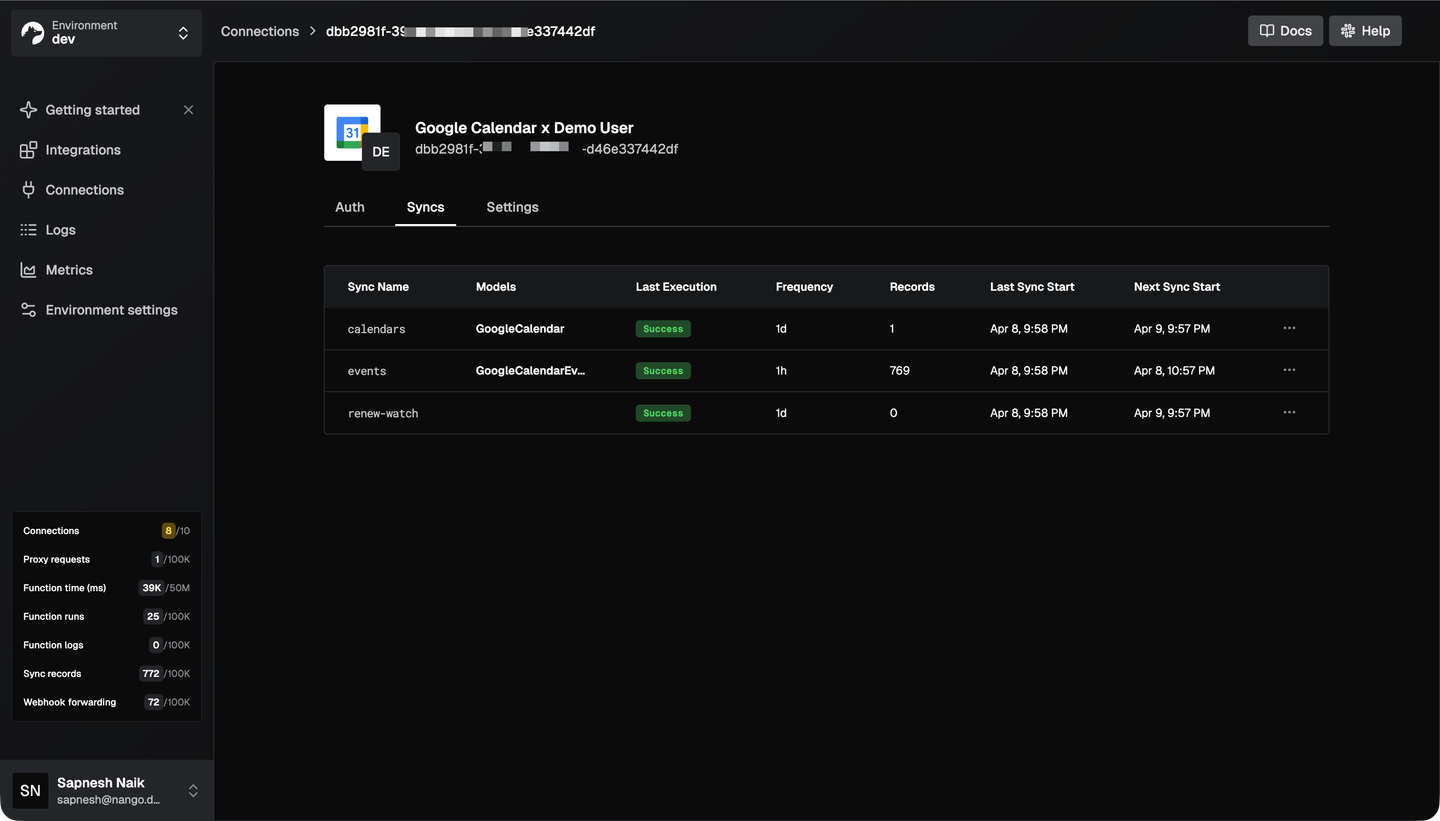
Nango is an integration platform for building API integrations with AI, which AI agents can use to securely access external APIs. It supports 1,000+ APIs and provides 7,000+ pre-built tools and syncs that teams can use out of the box and customize when needed.
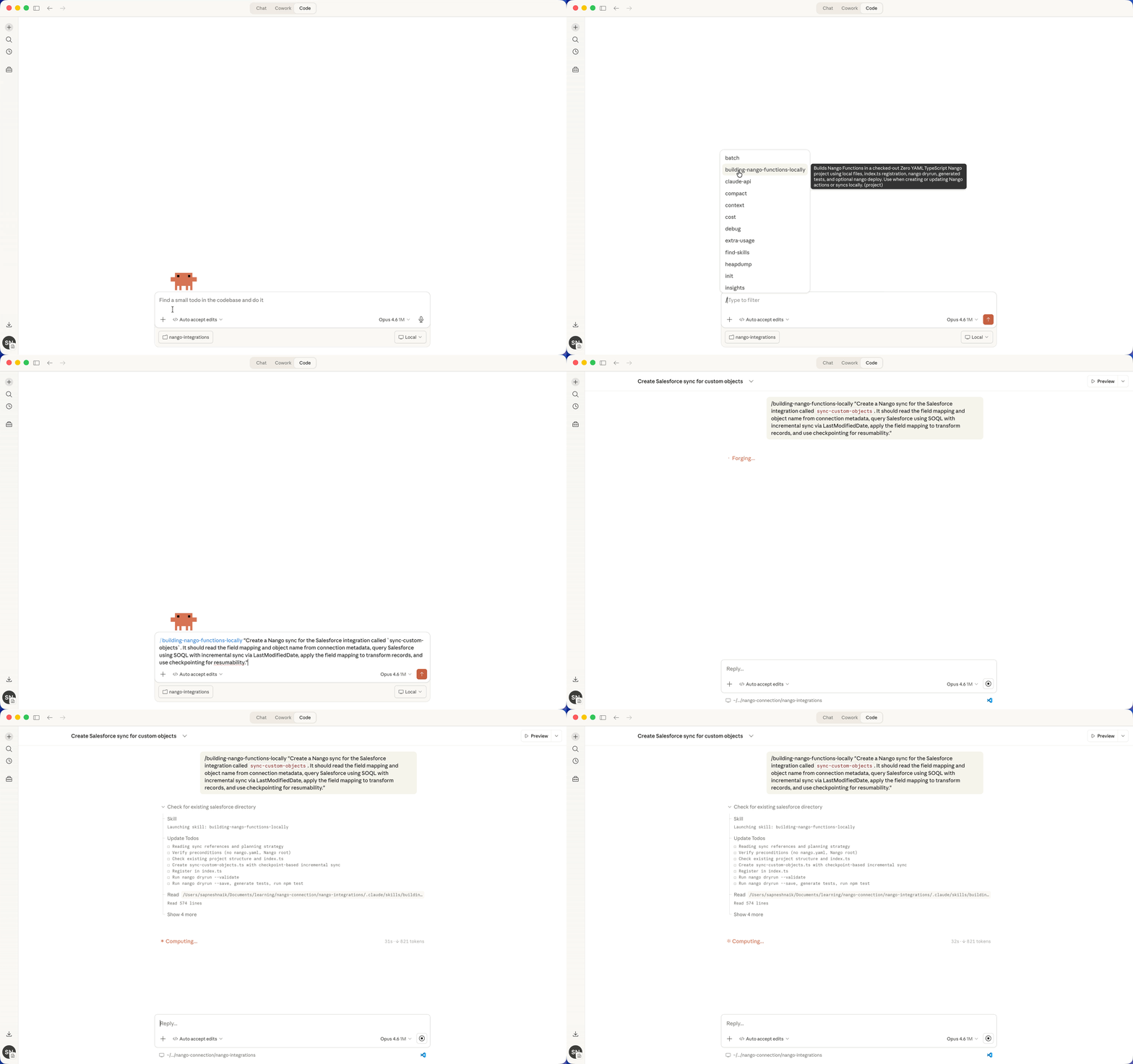
Coding agents such as Claude Code, Cursor, and Codex can build and customize integrations using the Nango builder skill. Nango provides the runtime for authentication, tool calls, data syncs, and webhooks. So teams do not have to build and operate this infrastructure themselves. Hundreds of AI companies use Nango in production.
Best for
Engineering teams building customer-facing agent integrations that need broad API coverage and compliance controls, including HIPAA with a BAA, flexible data residency, request-level logs, and control over where the integration runtime runs.
Pros
- Certifications with procurement documents attached: SOC 2 Type II, GDPR, and HIPAA, with a DPA that applies automatically to every cloud account and a BAA available on request, alongside a public subprocessor list in the trust center.
- Residency without leaving the managed platform: Enterprise bring-your-own-cloud runs a fully managed Nango inside your own AWS, GCP, or Azure account and region, at feature parity with the cloud. Free self-hosting exists for teams that want to run it themselves.
- Credentials that never reach the model: OAuth tokens, API keys, and client secrets are encrypted at rest with AES-256-GCM and injected server-side at call time, with TLS 1.2 or higher in transit and per-connection revocation.
- Well-documented retention policies: Deleted connections are purged after a 31-day soft-delete window, configurable when self-hosted. Synced record payloads are pruned after 30 days of inactivity and deleted after 60 days without a sync. Expedited purges are available for regulatory requests.
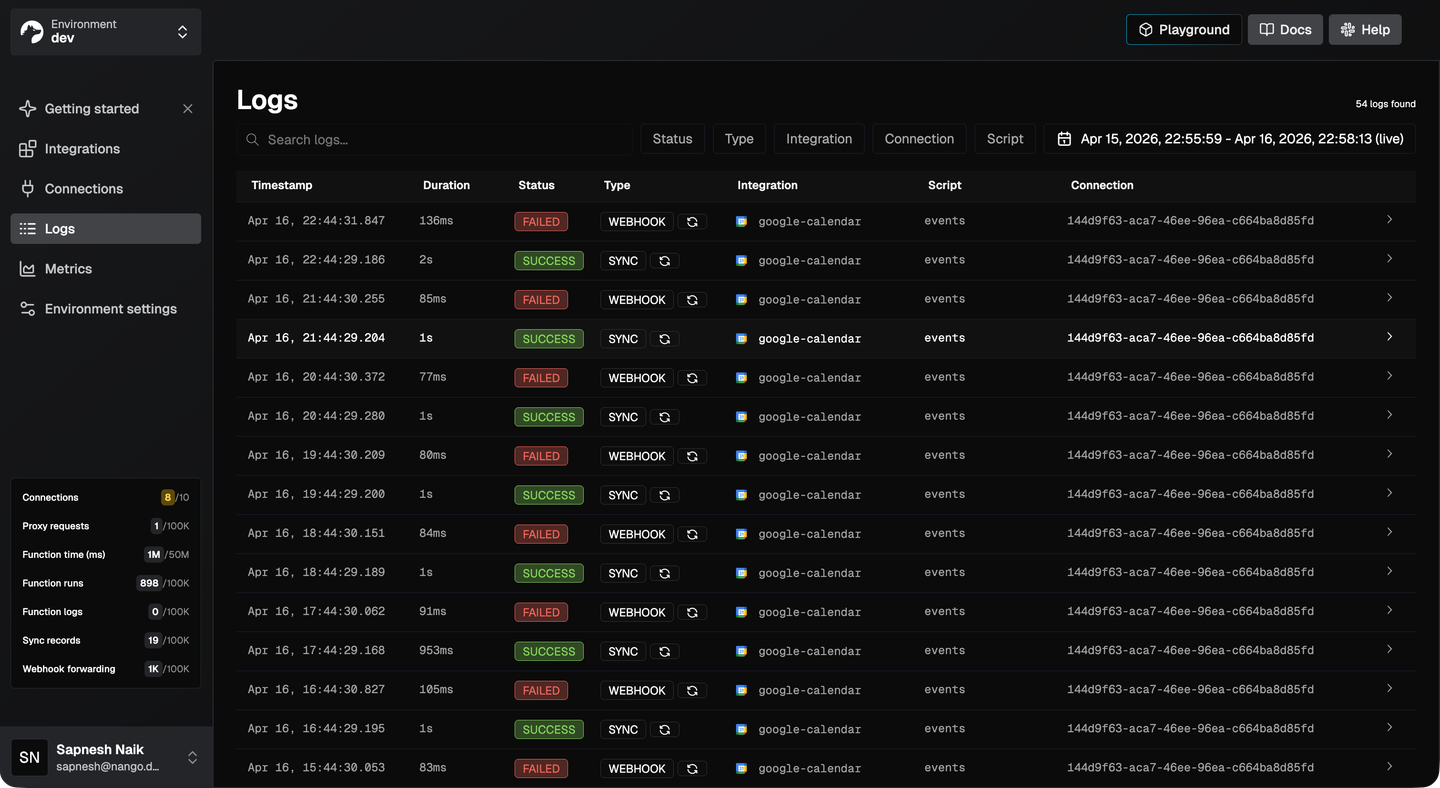
- Request-level audit trail: Every tool call, sync, and webhook produces a structured log with the connection, the external request, and the outcome, exportable to your own stack over OpenTelemetry.
- Access control across people and agents: RBAC, SAML SSO, permission-scoped API keys, and environment isolation so production credentials never mix with development.
- An auditable runtime, built by your coding agents: The platform is open source on GitHub, so a security reviewer can read the code that stores tokens and executes tools. Claude Code, Cursor, and Codex build and customize the integrations themselves through the Nango builder skill.
Cons
- Free self-hosting is scoped: Functions, syncs, webhooks, MCP, RBAC, SAML, and OpenTelemetry export require Enterprise self-hosting or Nango Cloud. The split is documented on the self-hosting page.
- Custom integration code is yours to review: Nango runs what you deploy, but a custom tool your team or your coding agent writes is your code and enters your own change-management process.
2. Merge
Overview
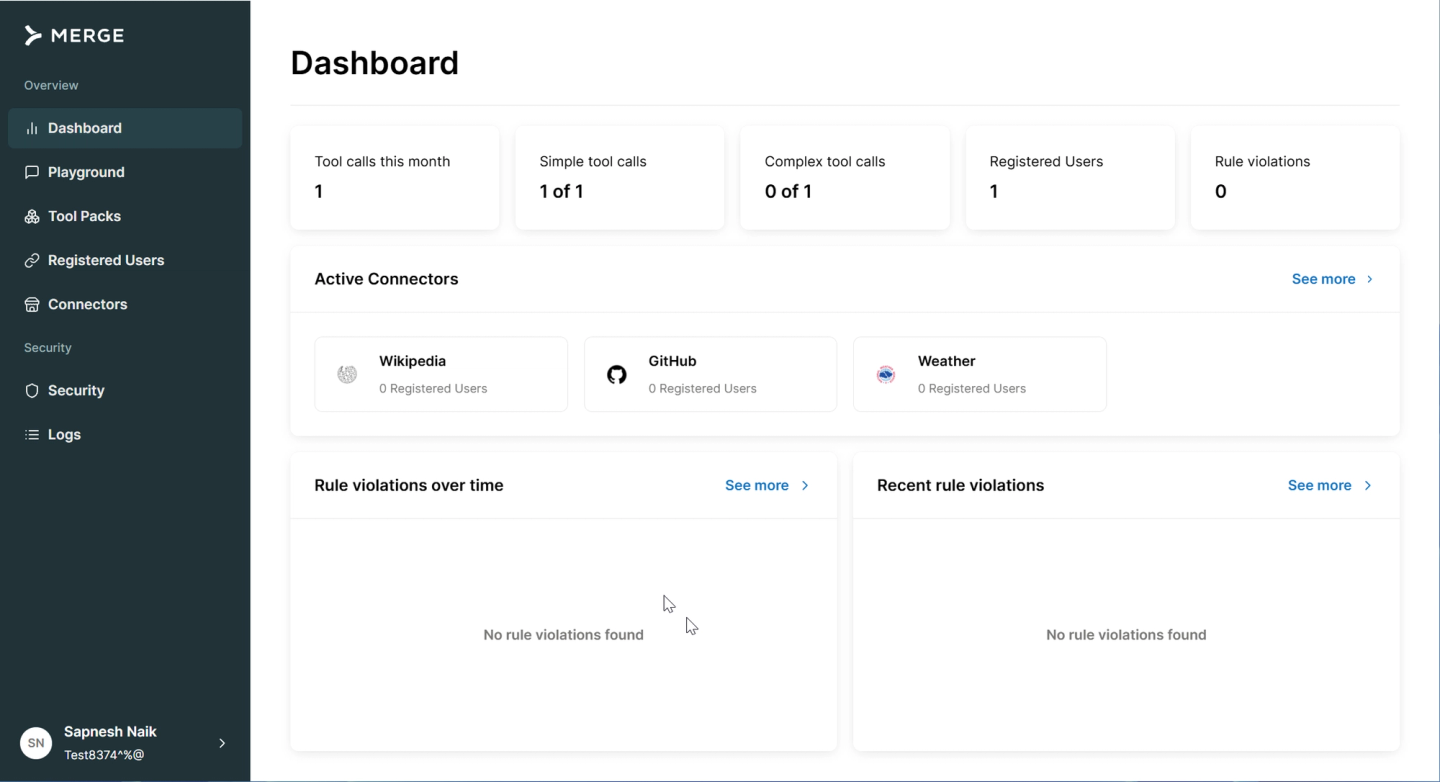
Merge offers Agent Handler for connecting AI agents to thousands of pre-built tools. It handles authentication and tool execution, with controls for monitoring agent activity. Merge also offers Unified for customer-facing integrations across hundreds of apps through normalized APIs.
Best for
Teams that want a large catalog of pre-built agent tools, documented compliance controls, and regional cloud hosting without managing the integration infrastructure themselves.
Pros
- Broad compliance coverage: Merge supports SOC 2 Type II, ISO 27001, HIPAA, GDPR, and CCPA. A business associate agreement (BAA) is available for HIPAA-covered use cases.
- Flexible data residency with single-tenancy: Merge offers multi-tenant hosting in the US, EU, and APAC. It also supports single-tenant deployments in a region of the customer’s choice, with dedicated Merge-hosted servers and databases, separated from those of other customers. Data is encrypted at rest and in transit, with an additional layer of application encryption for personally identifiable information (PII).
Cons
- No deployment in your own cloud: Agent Handler stores credentials, configuration, tool call logs, and audit trail data in Merge-managed AWS infrastructure. Enterprise customers can pin storage to other regions, but the platform does not run in your own cloud account.
- Long-term audit retention needs additional setup: Tool call logs are retained for 90 days on standard plans, with longer retention on Business and Enterprise. Programmatic log streaming to a security information and event management (SIEM) system or data warehouse is an Enterprise feature, and the log endpoints expose only the last 30 days of records.
3. Workato
Overview
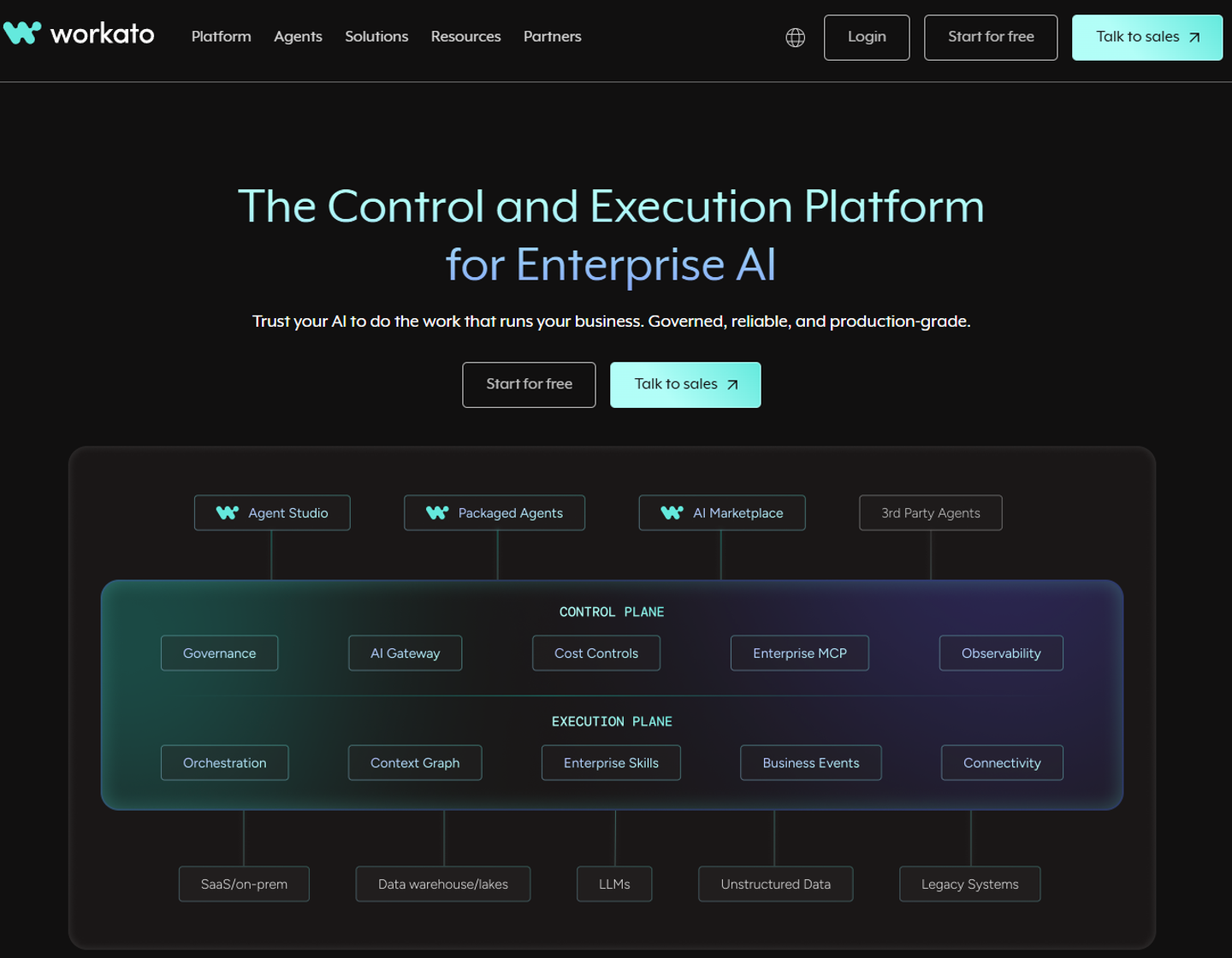
Workato is an enterprise automation and orchestration platform with tools to build and govern AI agents and MCP servers. Enterprise MCP can expose Workato API collections, recipes, and skills as tools that external AI agents can call.
Best for
Enterprise IT and operations teams that need agent integrations alongside centralized automation, governance, and a broad set of compliance certifications.
Pros
- Broad certification coverage: Workato supports SOC 1 Type II, SOC 2 Type II, SOC 3, ISO 27001, ISO 27701, and ISO 42001 for AI management systems. It also supports HIPAA with BAAs, PCI-DSS v4.0.1 Level 1, IRAP at the Australian PROTECTED level, and NIST 800-171A r2.
- Isolation and key custody options: Virtual Private Workato runs the platform in a dedicated AWS VPC, with Enterprise Key Management and External Secrets Management for teams that need to hold their own keys.
Cons
- No self-hosted Workato deployment: Virtual Private Workato provides dedicated AWS infrastructure, and Workato offers regional data centers, but the platform does not run in your own cloud account. Its on-premises agent connects private applications and databases back to Workato Cloud rather than self-hosting the platform.
- Integration logic is managed inside Workato: Agent tools are primarily built as recipes and skills in Workato rather than as integration code in your application’s repository. Workato provides development environments, deployment controls, and activity audit logs, but teams that require Git-native integration workflows may prefer a code-based model.
4. Paragon
Overview
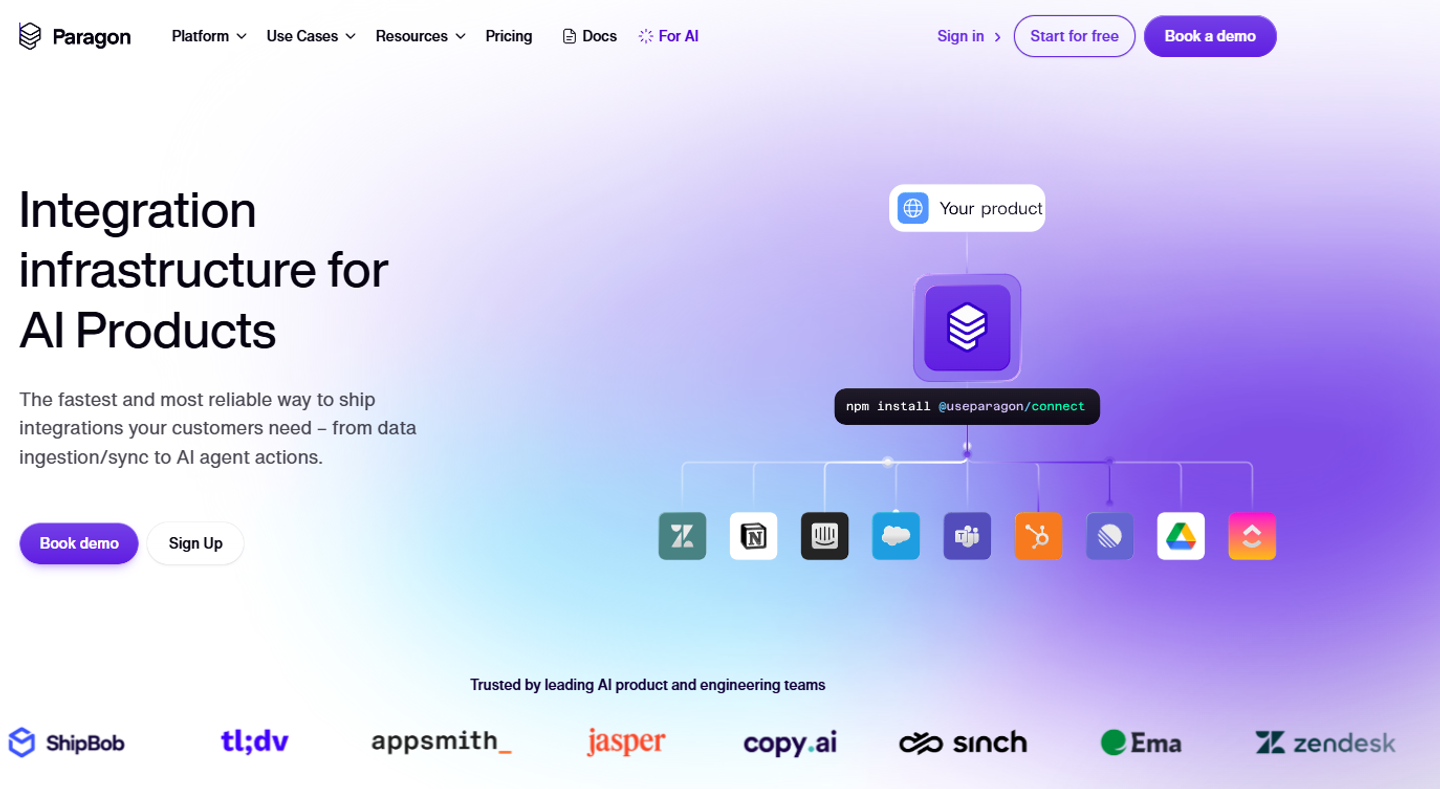
Paragon provides integration infrastructure for SaaS and AI products. ActionKit gives AI agents access to pre-built integration actions through an API or MCP server. Managed Sync handles data ingestion and includes a Permissions API for preserving access controls on synced data.
Best for
Teams building AI products that need agent tool calls and permissions-aware data ingestion, particularly for retrieval-augmented generation (RAG) over customer data.
Pros
- More control over where Paragon runs: Paragon supports SOC 2 Type II, HIPAA, and GDPR. For teams that cannot use the standard cloud deployment, Paragon can also be self-hosted. Enterprise customers have forward-deployed and single-tenant options.
- Permissions carry over to synced data: Managed Sync can bring permissions in alongside third-party data. Applications can then use the Permissions API to check a user’s access before returning that data to an agent.
- Logs and access controls are built in: Event Logs record activity for integration actions. Paragon also supports RBAC and SAML SSO for access to the admin console.
Cons
- No direct SIEM export for audit logs: Paragon records agent actions in Event Logs. But it does not currently forward this audit trail directly to an external SIEM system.
- Some compliance controls require Enterprise: Self-hosting, forward deployment, RBAC, and SAML-based SSO are Enterprise features. Pro keeps task history for 90 days, while Enterprise provides unlimited retention.
5. Arcade
Overview
Arcade provides infrastructure for connecting AI agents to tools and MCP servers. It handles user authorization, credential management, tool execution, and access controls at runtime.
Best for
Teams that need MCP-based tool calling with per-user authorization and want the option to run the platform in their own cloud for data residency.
Pros
- Flexible deployment for data residency: Arcade Cloud runs in the US, but the full platform can also run in your own infrastructure. Arcade offers managed deployments in your Azure or AWS account, or you can self-host with Helm on your own Kubernetes cluster.
- Sensitive credentials get additional encryption: Arcade uses AES-256 encryption at rest. Tokens and secrets receive another AES-256 encryption pass before they are stored.
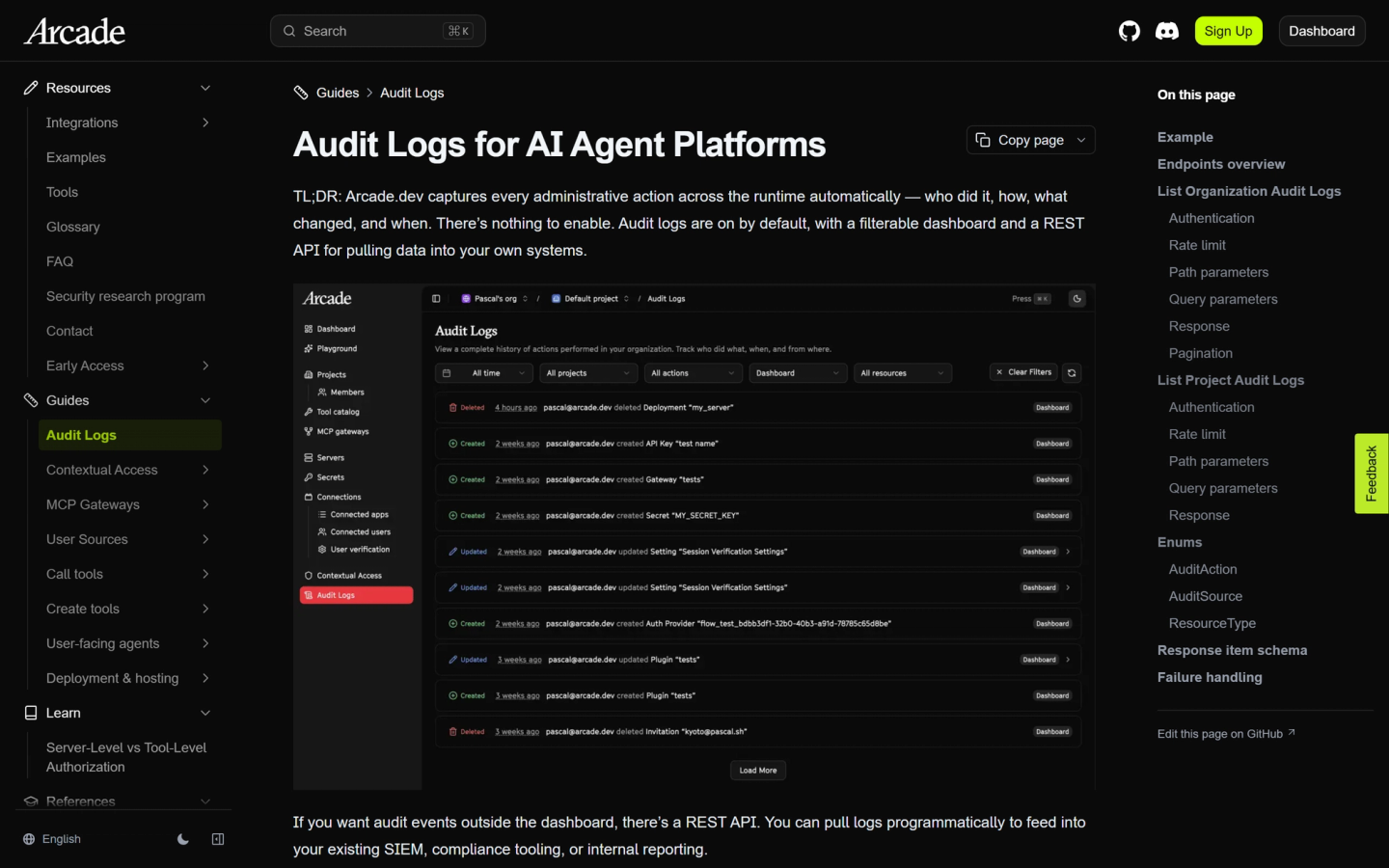
- Built-in auditability: Arcade provides audit logs for administrative activity and execution logs for tool calls. Its current platform also supports OpenTelemetry audit logs for exporting observability data.
Cons
- Arcade Cloud is US-only: All Arcade Cloud infrastructure, including data storage and processing, is located in the United States. Teams with EU, APAC, or other residency requirements need to deploy Arcade in their own infrastructure.
- Training data is opt-out: Arcade may use tool queries, execution inputs, and execution results as training data and retain them for up to five years. Organization administrators can opt out at any time, which stops new training-data collection immediately.
- Self-hosting adds infrastructure responsibility: Teams that choose the Helm deployment manage their own Kubernetes cluster, data, and upgrade cadence. Arcade-operated Azure and AWS deployments reduce that operational work while keeping the platform in the customer’s cloud account.
6. Composio
Overview
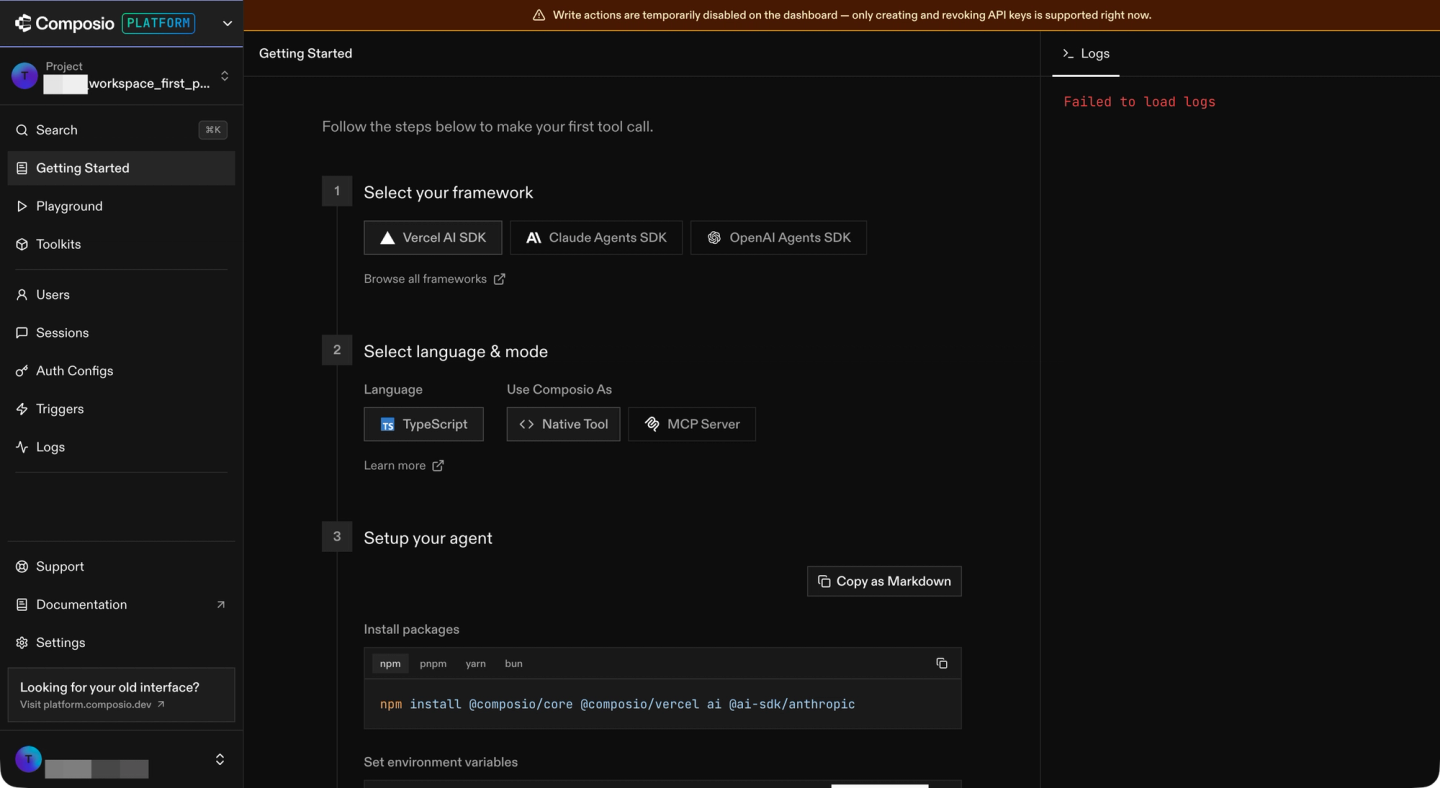
Composio provides agent infrastructure with 1,000+ integrations, managed authentication, and just-in-time tool calls. Agents can search for the tools they need instead of loading the full catalog into context.
Important:
Composio disclosed a security incident on May 21, 2026. The incident affected 5,001 GitHub connections, while an auxiliary cache containing 5,241 API keys was also considered potentially exposed. Composio revoked affected credentials where possible and required customers to rotate Composio API keys as part of the response.
Best for
Teams that want a large catalog of agent-ready integrations with managed authentication. They can use Composio’s managed infrastructure or its enterprise deployment options.
Pros
- SOC 2 Type II and ISO 27001: Composio maintains both certifications and provides enterprise controls for security reviews.
- Control over payload retention: Zero data retention (ZDR) prevents Composio from retaining request and response payloads. Audit records can retain metadata about tool calls without storing the payload itself.
- More deployment options for Enterprise: Composio now offers private deployment options for some enterprise products, including VPC and self-hosted deployments.
Cons
- Some compliance features cost extra: On Pro, a BAA costs an additional $500 per month. ZDR is also metered at $0.0001 per tool call and $0.0005 per trigger event.
- The May 2026 incident remains part of the security review: Composio disclosed unauthorized access that affected thousands of connected credentials. Teams evaluating the platform need to account for that incident and Composio’s remediation in their vendor review.
- Some controls depend on the plan or deployment: Features such as ZDR, BAA support, private deployment, and advanced enterprise controls are not part of the standard configuration.
- On-prem deployment difficulty: A customer who moved from Composio to Nango reported that deploying Composio on their own infrastructure was difficult.
For the alternatives, see Composio alternatives and how to migrate from Composio to Nango.
What about AI governance platforms?
AI agent governance tools such as IBM watsonx.governance, Credo AI, and ServiceNow AI Control Tower are a different category. They inventory models and agents, map policy to frameworks like the EU AI Act, ISO 42001, and the NIST AI RMF, and produce evidence for a risk committee. An AI compliance platform in that sense governs the decision to run an agent.
The platforms compared here govern the execution. They hold the credential, run the call against the external API, and produce the record that a governance tool later reports on. Enterprise AI agents usually need both, and the integration layer is the one that has to pass the security review before anything ships.
Comparison of solutions
| Criterion | Nango | Merge | Workato | Paragon | Arcade | Composio |
|---|---|---|---|---|---|---|
| Certifications | SOC 2 II, GDPR, HIPAA | SOC 2 II, ISO 27001, HIPAA | SOC 1/2/3, ISO 27001/27701/42001, PCI-DSS, HIPAA | SOC 2 II, GDPR, HIPAA | SOC 2 II | SOC 2 II, ISO 27001 |
| HIPAA BAA | On request | Available | Available | Confirm with vendor | Not verified | Paid add-on |
| Data residency | Any region via BYOC | US, EU, APAC, customer-selected single-tenant region | Regional data centers | Self-hosting and private deployment options | US cloud or customer's infrastructure | Private deployment options available |
| Deployment | Cloud, BYOC, self-host | Merge-hosted, including single tenant | Workato Cloud, Virtual Private Workato | Cloud, Enterprise self-host/forward deployment | US cloud, managed AWS/Azure, self-hosted Kubernetes | Cloud, Enterprise private deployment |
| Credential handling | AES-256-GCM, server-side injection | Encrypted, additional PII encryption | Encryption and customer key options | Encrypted | AES-256 plus additional encryption for secrets | Managed authentication |
| Retention | Documented connection and sync retention | 90-day tool call logs on standard plans | Configurable | 90-day Pro task history, unlimited Enterprise | Training data up to 5 years unless opted out | ZDR available |
| Auditability | Request-level logs, OpenTelemetry | Tool call and audit logs, SIEM export on Enterprise | Activity audit logs | Event Logs, no direct SIEM export | Admin and execution logs, OpenTelemetry | Tool-call audit metadata |
| Access control | RBAC, SAML SSO, scoped keys | RBAC, SSO | Enterprise access controls | RBAC, SAML SSO | Runtime access controls | Enterprise controls |
| Private infrastructure | BYOC and self-hosting | Single tenant, Merge-hosted | Dedicated AWS VPC | Self-host/forward deployment | Customer AWS/Azure or Kubernetes | VPC/self-host options for some Enterprise products |
| Notable compliance consideration | Free self-hosting has limited features | No deployment in customer's cloud | No self-hosted platform | Some controls require Enterprise | Training-data collection is opt-out | May 2026 security incident |
How we applied the criteria
We checked every row against each vendor’s own documentation, trust portal, pricing page, and changelog on August 27, 2026, and treated documentation as authoritative where it disagreed with marketing pages. Where a control was neither documented nor demonstrable, the cell records that rather than assuming absence. Retention figures are the published defaults, not what a negotiated enterprise contract might allow.
FAQ: AI agent compliance
Which AI agent integration platforms are SOC 2 Type II certified?
All six here claim SOC 2 Type II, so the certification alone no longer separates vendors. Ask what the report covers and whether it is shared under NDA. Nango publishes SOC 2 Type II, GDPR, and HIPAA evidence in its trust center along with a subprocessor list, and its runtime is open source, so a reviewer can read the code rather than only the attestation.
Which vendors will sign a HIPAA BAA, and what does it cost?
Merge publishes its BAA publicly. Nango offers HIPAA with a BAA as an add-on, while Workato also makes BAAs available. Composio charges an additional $500 per month for a BAA on Pro+. We could not verify public BAA terms for Arcade or Paragon, so confirm them directly with the vendor before processing protected health information (PHI).
Can I self-host an agent integration platform for EU data residency?
Yes. Nango supports self-hosting and Enterprise bring-your-own-cloud (BYOC), which runs a managed Nango deployment in your own AWS, Google Cloud, or Azure account and chosen region. Arcade and Paragon also provide self-hosted or customer-cloud deployment options.
Merge does not run in your own cloud account, but it provides multi-tenant hosting in the US, EU, and APAC, plus single-tenant hosting in a region of your choice. Workato provides regional cloud infrastructure and Virtual Private Workato, but not a self-hosted deployment.
How do I keep agent credentials out of the model?
Keep credentials in the integration runtime rather than passing them to the model. The agent calls a named tool, and the runtime retrieves the appropriate credential and injects it when making the external API request. The model receives the tool result without receiving the underlying OAuth token or API key.
Nango’s tool-calling flow follows this pattern. For the broader architecture, see the guide to secure AI agent API authentication.
What should I ask an integration vendor during a security review?
Start with five questions:
- Where does the managed platform run, and can it run in our cloud account?
- What data do you retain from tool calls, for how long, and can we turn retention off?
- Do you record individual tool executions, and can we export those logs?
- Will you sign a BAA and DPA, and which plans or services do they cover?
- Have you disclosed any security incidents, and what remediation did they require?
These answers reveal more about the platform’s compliance fit than a SOC 2 badge alone.
Is GDPR compliance realistic on a US-hosted integration platform?
Yes, but hosting data in the US can introduce additional requirements. Transfers of personal data outside the European Economic Area need an appropriate mechanism under GDPR Chapter V, and customers may have additional residency requirements in their own contracts and DPAs.
For teams with strict EU residency requirements, an EU-hosted region or a deployment in their own EU cloud account can simplify the architecture and vendor review.
Conclusion
Certifications separate vendors less than they used to, since all six platforms here hold SOC 2 Type II. What separates them is where the platform runs, what it keeps from each tool call, and whether the controls a security review asks for are defaults or line items on an order form.
Of the six platforms here, Nango is the strongest fit for teams that need both breadth and provable compliance. It connects agents to 1,000+ APIs with 7,000+ pre-built tool calls, carries SOC 2 Type II, GDPR, and HIPAA with a BAA, runs in your own cloud account and region through bring-your-own-cloud, logs every tool call, and is open source so the runtime holding your customers’ credentials can be read rather than trusted. Coding agents like Claude Code, Cursor, and Codex build the API integrations themselves, so the catalog is a starting point rather than a ceiling.
To get started, follow the Nango quickstart.
