
AI agents increasingly connect to external APIs and need API integrations for tasks like refunding payments or updating records in Salesforce. Enterprises are also looking for secure, compliant, and easy-to-integrate platforms for AI agents.
This post compares six integration platforms for enterprise AI agents in detail: Nango, Arcade, Composio, Pipedream Connect, Workato, and Paragon. For the general comparison, see Best AI agent integration platforms.
TL;DR
For an enterprise, the integration platform becomes part of your product’s security surface. It stores customer credentials, executes calls on their behalf, and is reviewed as part of every security review and procurement process.
Three platforms worth evaluating in 2026:
- Nango: An integration platform connecting your AI agent to 1,000+ APIs and 7,000+ pre-built tool calls, customizable with code. SOC 2 Type II, GDPR, and HIPAA with a BAA, deployable in any region via bring-your-own-cloud. Open source.
- Arcade: An MCP-native runtime with per-user authorization, scoping credentials per tool. SOC 2 compliant, with RBAC only rolling out in July 2026, and tool calls are not audit logged. No syncs or webhooks.
- Composio: A hosted catalog of 1,047 toolkits. Closed-source runtime and a history of security incidents, with governance and audit gated behind the enterprise tier. Suits internal automation more than customer-facing integrations.
We also cover Workato, Pipedream Connect, and Paragon below, but they suit narrower cases than the three above.
What are integration platforms for AI agents?
An integration platform for AI agents sits between an agent and the external APIs it acts on. It handles the work that is time-consuming and security-sensitive to rebuild for every provider: the OAuth handshake and credential storage, a tool definition for each API operation, execution with the correct end user’s credentials, and an audit trail for every call.
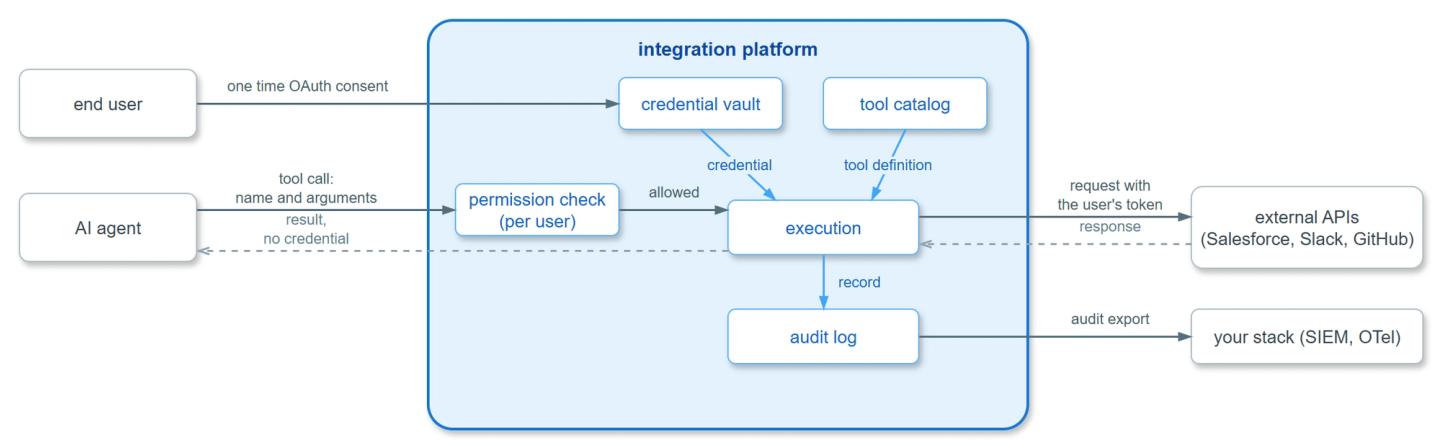
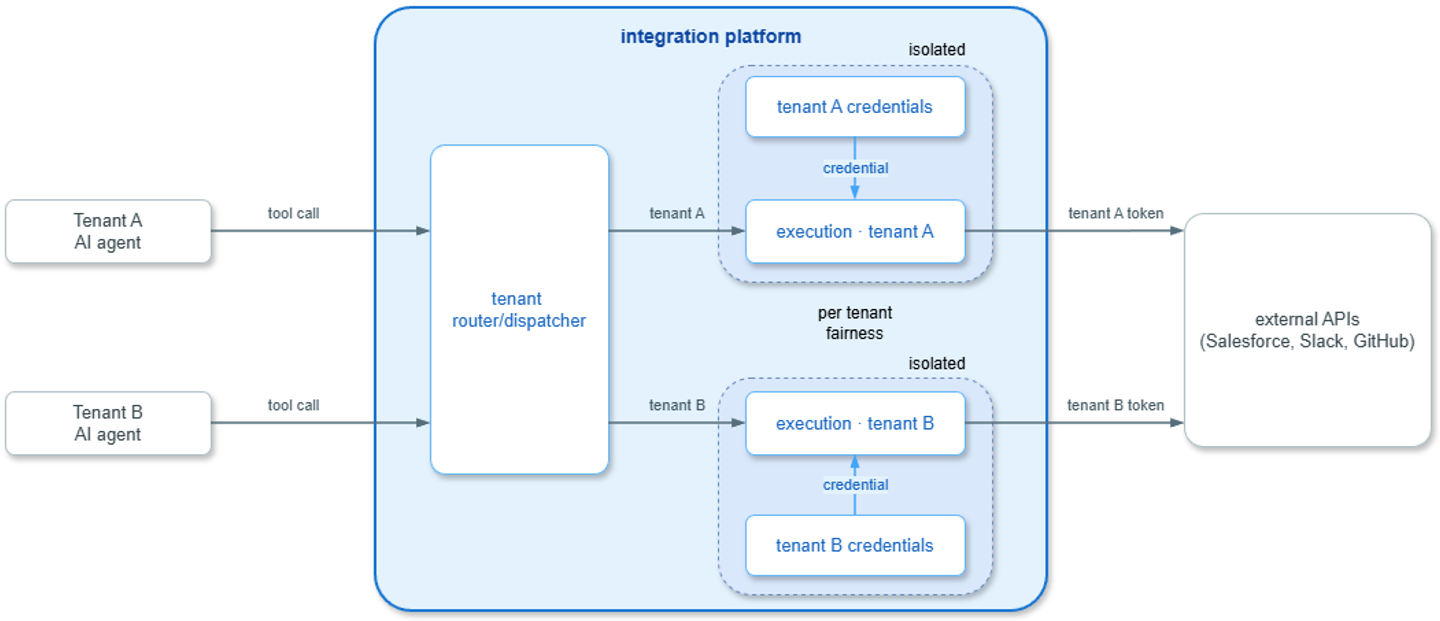
In a product with more than one customer, the platform also routes each tenant to its own credentials, checks that the calling user is permitted to run a given tool before it runs, and executes calls in isolation with an audit trail for each call. It also queues each tenant’s work fairly, so one customer’s load does not delay another.
This platform stores your users’ credentials and calls external APIs on their behalf. Those responsibilities place it within the scope of a security review, unlike most dependencies a team adds.
Note: Most platforms expose tools over the Model Context Protocol, direct API calls, or both. The choice is covered in detail in MCP vs tool calls for AI agents.
What makes an agent integration platform enterprise-ready?
We use the following criteria to determine whether a platform meets enterprise requirements. They cover what a security review checks for, and whether the team can ship the integrations its product needs.
| Criterion | What to verify |
|---|---|
| Compliance | SOC 2 Type II and its scope, GDPR with a signed DPA, HIPAA with a BAA |
| Deployment | Managed cloud, private deployment, self-hosting maturity, EU data residency |
| Security architecture | Credential encryption, key custody, tenant execution isolation, and incident history |
| Governance | RBAC, SSO, and SAML, per-user permission checks on tool calls, approval flows |
| Observability | Request-level tool-call logs, administrative audit trails, SIEM export |
| Tool-call overhead | A published latency figure, with the methodology, percentile, and test setup behind it |
| Tenant fairness | Per-tenant queues or concurrency caps, so one customer's load does not delay another's |
| Ownership | Whether tool definitions live in your version control, reviewed, and deployed like application code |
| Open source | Whether the runtime that executes your tools is public and auditable, and whether you could keep running it if the vendor disappeared |
| Coding agents build integrations | Whether coding agents like Claude Code, Cursor, and Codex can research an API, write the integration as code, and test it against a real connection |
| Breadth | Catalog size, custom tools as code, Git, and CI workflow |
| Support | Contractual SLAs, dedicated support, DPAs, and subprocessor lists |
For more on the authentication criterion, see the guide to secure AI agent API authentication.
Best enterprise-ready AI agent integration providers
1. Nango
Overview
Nango connects your AI agent to 1,000+ APIs and 7,000+ pre-built tool calls, with managed auth and credential storage. You can use the catalog out of the box, then customize what you need with code on infrastructure built for scale. Hundreds of AI companies run Nango in production.
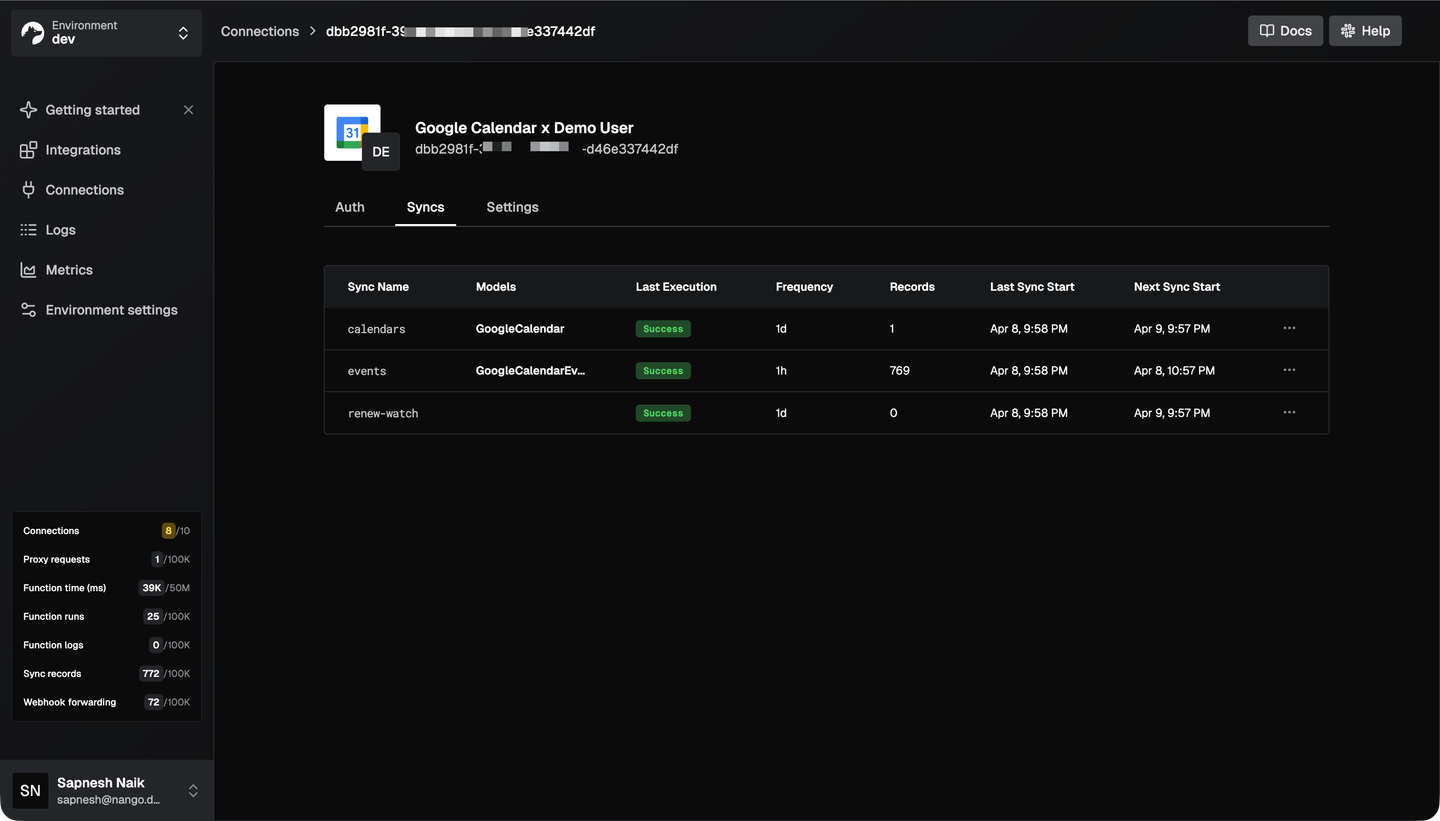
Nango also supports data syncs (pulling external data for RAG context) and webhooks on the same platform.
Best for
Teams looking for a large API catalog and customizable pre-built tool calls for AI agents. Also suitable for teams seeking full enterprise readiness with multi-tenant isolation, access control, audit trails, compliance (SOC 2, GDPR, HIPAA), and deployment in their own cloud and region.
Pros
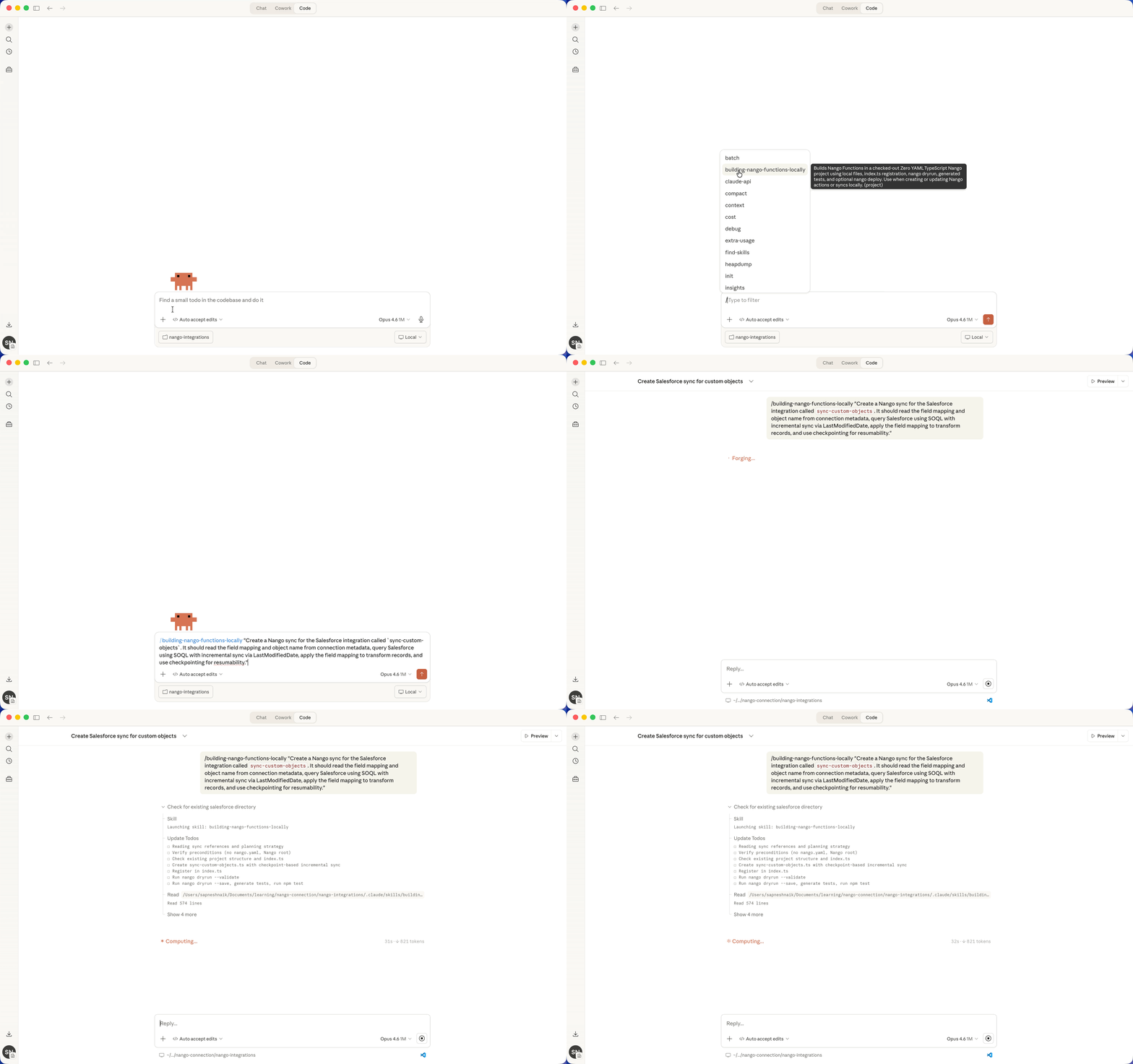
- Wide API coverage and tool-call support: Connect agents to 1,000+ APIs across every auth type (OAuth, JWT, ID-JAG, Basic) with 7,000+ pre-built tool calls, customizable with an AI coding agent through the Nango API integrations builder skill.
- Compliance and procurement: SOC 2 Type II, GDPR with a DPA that applies to every cloud account, and HIPAA with a BAA on request, backed by a public subprocessor list and a trust center.
- Multi-tenant runtime: Each customer’s executions run isolated and fairly queued on a scalable runtime, with AES-256-GCM credential encryption and tool-call overhead under 100ms.
- Permissions and audit trail: RBAC, SAML SSO, and permission-scoped API keys enforce what each user and agent can do, and every tool call, sync, and webhook is logged and exportable over OpenTelemetry.
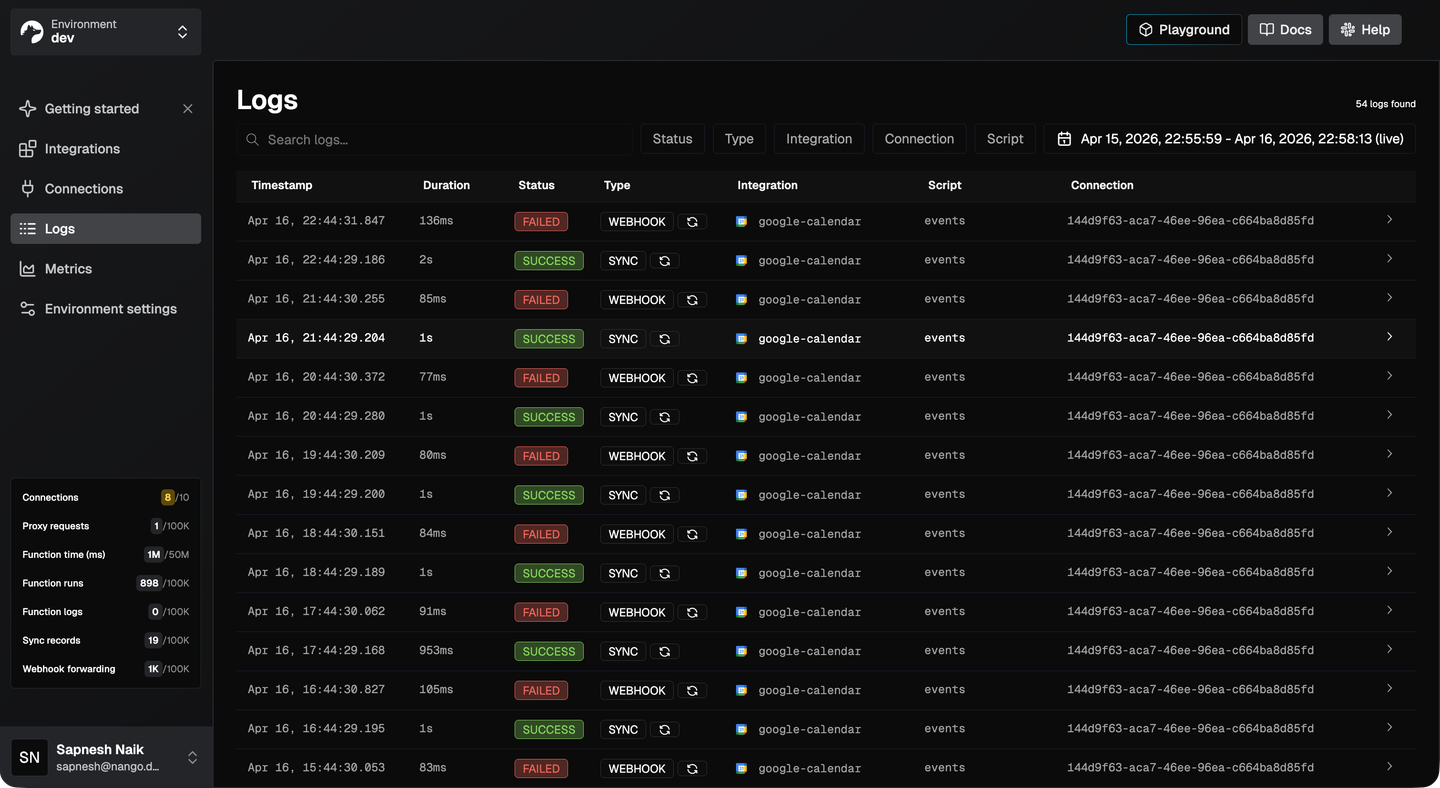
- Data syncs and webhooks: Sync data from external APIs for RAG, or trigger agents on webhooks from external APIs on the same platform.
- Mature self-hosted offering (BYOC): Enterprise bring-your-own-cloud runs a fully managed Nango in your own cloud account and region, at feature parity with the managed cloud.
- Open source, customizable with code: Build a tool as TypeScript in your own repo and review it like application code, on a runtime that is open source on GitHub so you can audit what executes your tools.
Cons
- Free self-hosting is scoped: Functions, syncs, webhooks, MCP, RBAC, SAML, and OpenTelemetry export need Enterprise self-hosting or Nango Cloud. The split is documented.
2. Arcade
Overview
Arcade is an MCP-native tool-calling runtime built around delegated user authorization. Credentials are scoped to each tool, consent is stepped up as new scopes are needed, and the token itself is never exposed to the model or the client.
Best for
Teams that only need MCP tool calling with per-user access control, can bring their own policy layer, and are okay with only a SOC 2 Type II certification.
Pros
- Tool metadata for policies: Read-only, destructive, idempotent, and open-world tags let admins govern tools by what they actually do.
- Self-hosting for data residency: Enterprise-plan self-hosting (including on-premises and air-gapped) is the documented way to keep data outside the US.
- Fits your existing stack: Works with popular agent frameworks and MCP clients like Cursor, Claude, and VS Code.
Cons
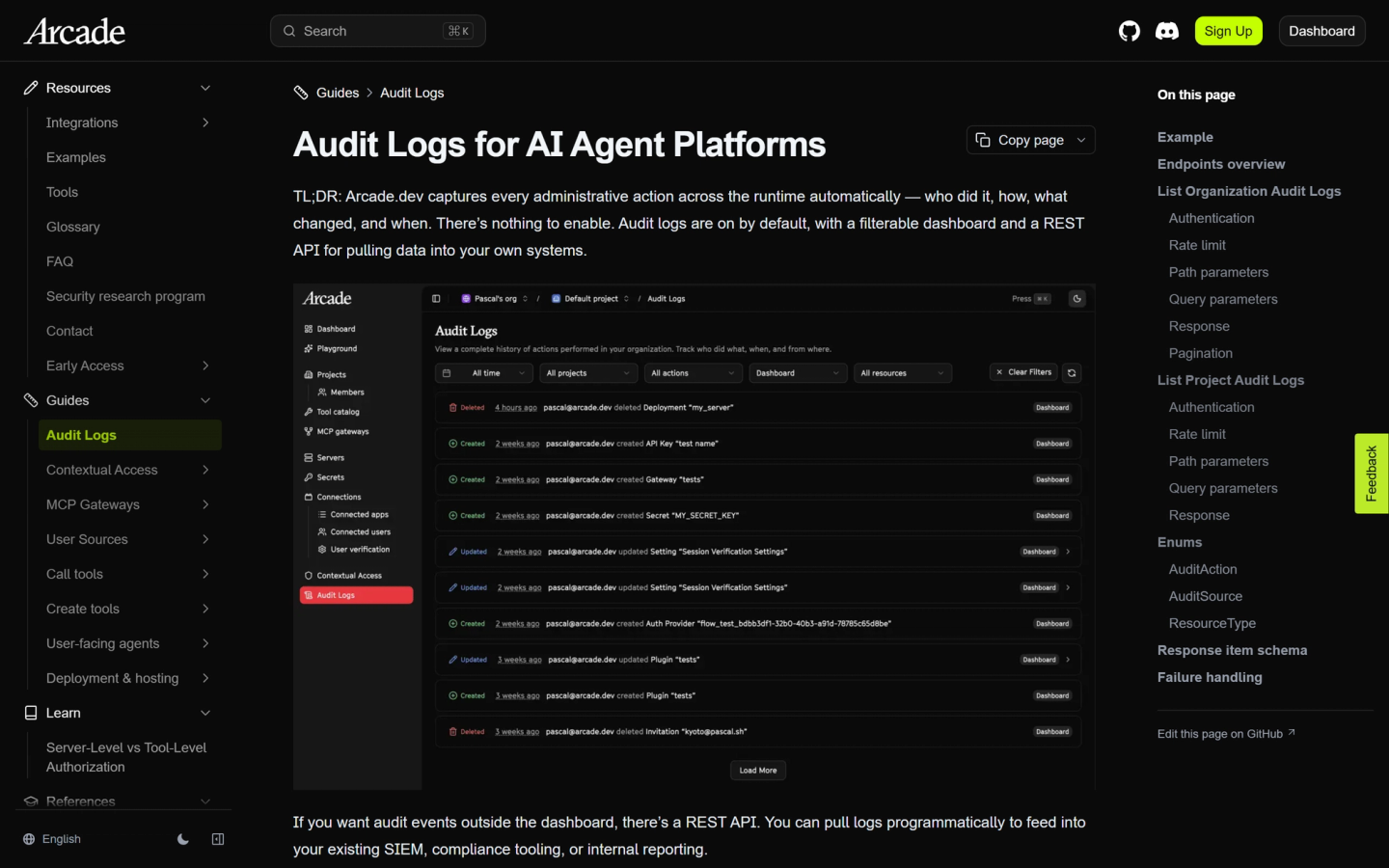
- Tool calls are not audit logged: Audit logs cover administrative events but not tool executions, which Arcade lists as future work. For a governance platform that is the compliance-critical event.
- RBAC only just shipping: Default RBAC began rolling out to new Cloud signups in July 2026 and is not yet generally available to existing organizations.
- Thin compliance: SOC 2 Type II is the only certification Arcade publicly claims, with no HIPAA BAA, ISO 27001, or published DPA, and the trust center is access-gated.
- US-only cloud: EU data residency requires full self-hosting.
- No syncs or webhooks: The catalog is around 80 toolkits and covers tool calls only, so retrieval and event handling need a second platform. The Engine that stores tokens and executes calls is proprietary, so only the tool-authoring framework can be audited.
3. Composio
Overview
Composio has 1,047 toolkits, and each toolkit can contain a large number of tools (over 800 for GitHub, for example). Its tool search lets an agent query the catalog and pull schemas on demand, so a large catalog does not have to be loaded into context up front.
Important:
In May 2026, Composio disclosed a security incident. A compromised employee Gmail OAuth token let an attacker intercept a magic-link sign-in to an internal tool, register malicious tool definitions, and reach the execution sandbox and the credential cache behind it. Around 5,001 GitHub OAuth tokens and 5,241 API keys were compromised or likely exposed.
Best for
Internal and personal automation, where a team connects its own agents to APIs rather than shipping integrations to end customers.
Pros
- Self-hosted deployment: Teams that cannot use the managed cloud can run Composio on their own infrastructure.
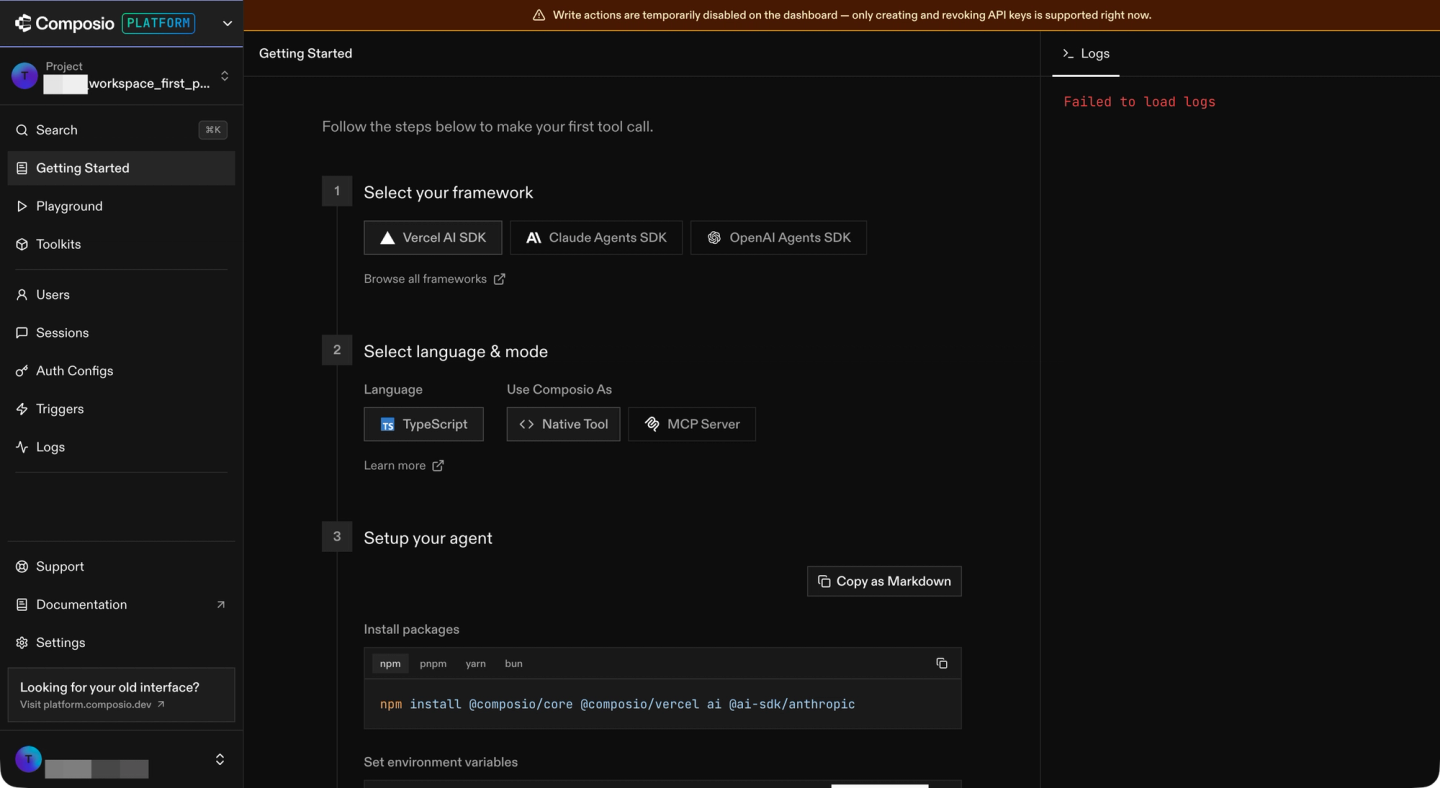
- Detailed execution logs: Rich filtering and full request/response payloads through the API.
- Broad framework support: MIT-licensed Python and TypeScript SDKs with adapters for popular agent frameworks.
Cons
- Fallout from the May 2026 incident: Composio mandated API key rotation for every customer, not only those affected, and the cleanup broke integrations. Its own status page records roughly 32 hours of broken CLI authentication across three days, and API-key connections it could not revoke on customers’ behalf were left for each end user to rotate at the provider.
- Closed-source runtime: The public repository holds SDKs and adapters only, so customers cannot audit what executes their tools.
- Governance and audit behind the enterprise tier: Composio documents five roles with action-level RBAC and audit trails for every tool call, but as enterprise-tier features rather than defaults on the lower paid plans.
- No HIPAA or BAA: Composio is certified for SOC 2 Type II and ISO 27001:2022, but its trust center lists no HIPAA compliance and it offers no Business Associate Agreement, so regulated health data is off the table.
A customer who moved from Composio to Nango reported difficulty deploying Composio on their own infrastructure. They also reported that Composio had raised their price to more than 10 times the previous amount.
For a direct comparison, see Composio vs Nango and Composio alternatives.
4. Pipedream Connect
Overview
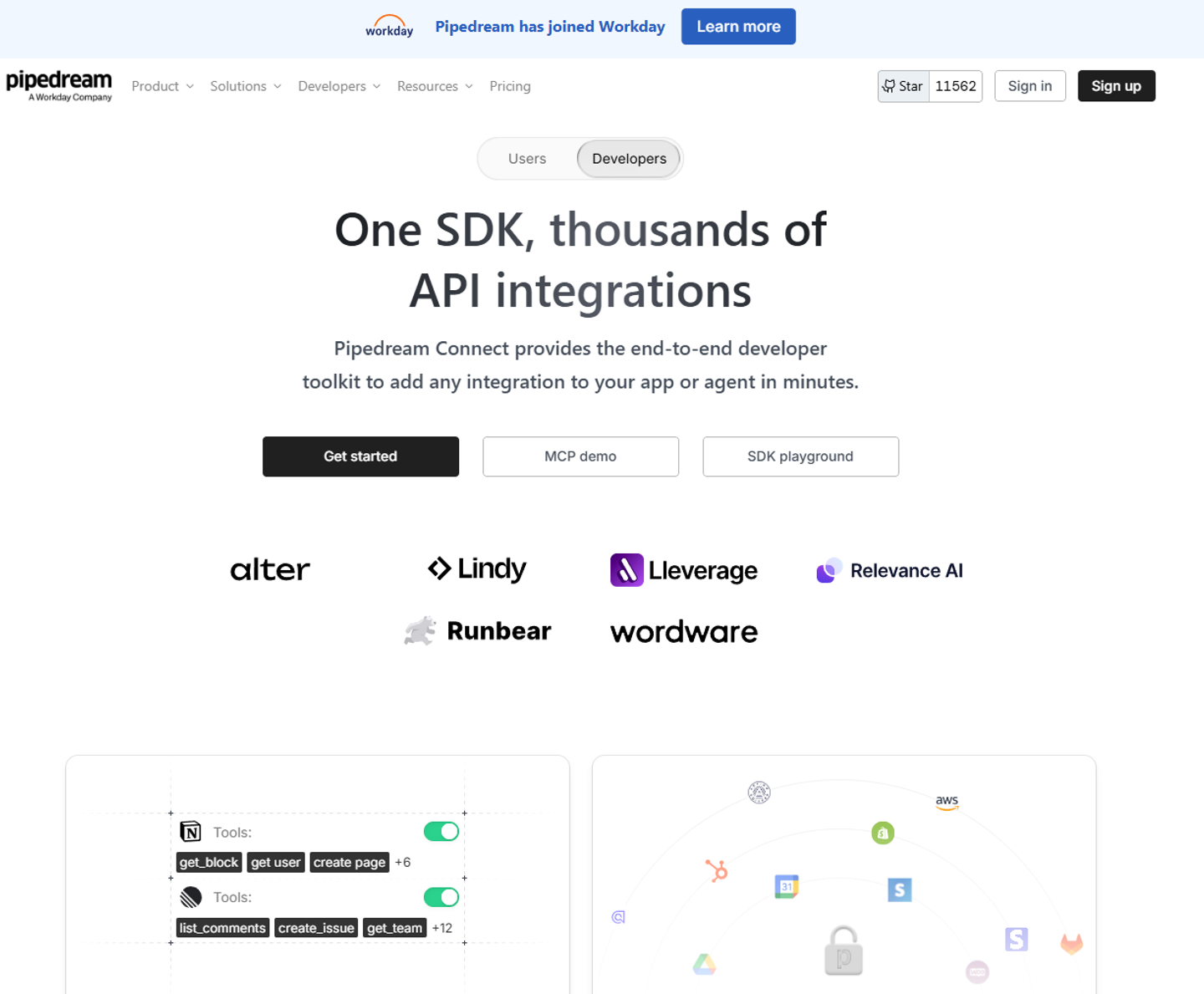
Pipedream Connect offers the broadest app coverage in this comparison, 3,000+ apps and 10,000+ tools, each behind managed authentication so an agent can call it without handling credentials.
Important:
Pipedream Connect appears to be no longer actively maintained. Pipedream’s changelog lists no release since October 2025, and its self-hostable MCP reference implementation, last updated in November 2025, is documented as no longer maintained. Workday’s acquisition of Pipedream was announced in November 2025.
Best for
Teams that want a large, open-source component catalog and a signed HIPAA BAA, and can accept that Connect is no longer actively developed.
Pros
- Auditable open-source components: Every Pipedream Connect component is defined as Node.js source in a public repository, so you can read exactly what a tool does before you ship it.
- HIPAA with a BAA: Pipedream signs Business Associate Addendums with Business-tier customers, and Connect is on its documented list of services eligible to handle PHI.
Cons
- No burst protection for tool calls: Pipedream’s tool calls run through the SDK, which its event queues do not cover, so a burst of calls hits cold-start delays instead of being queued.
- End-user isolation delegated to your app: Pipedream separates end users by an ID your app passes in, so isolation between them is only as strong as your own authentication.
5. Workato Embedded
Overview
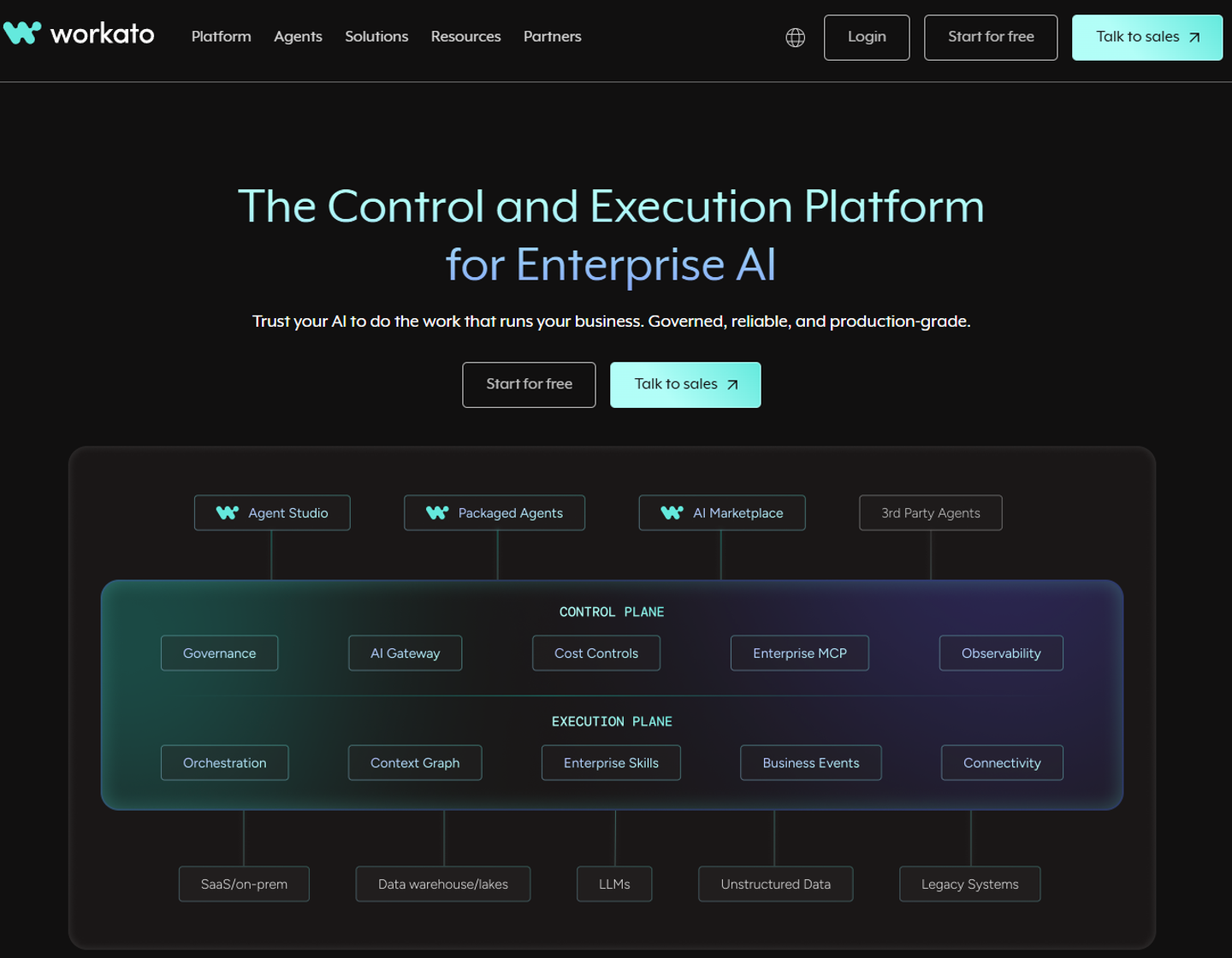
Workato is an enterprise automation platform built around a no-code visual builder and 1,200+ prebuilt connectors. Its Enterprise MCP offering exposes the recipes built there to agents as tools, with no integration code required.
Best for
Non-technical teams that want to expose recipes to agents through a visual builder, and value broad compliance coverage over a code-first workflow.
Pros
- Broad compliance coverage: SOC 1 and SOC 2 Type II, ISO 27001, ISO 42001 for AI management systems, and HIPAA with signed BAAs.
- Per-user identity with approvals: With Verified User Access, each action runs as the actual end user and inherits their own permissions, not those of a shared service account. Agent Guardrails can then route high-stakes actions to Slack or Teams for sign-off first.
Cons
- No code-first tool definition: Agent tools are recipes built in Workato’s visual builder, not authored in code, so the integration logic never enters your repository or code review.
- Cloud-only, with capacity you negotiate: The MCP server runs only in Workato’s cloud; the on-prem agent is a connectivity tunnel back to it, not a way to self-host. Recipe concurrency is capped at 30 jobs unless you ask support to raise it.
6. Paragon
Overview
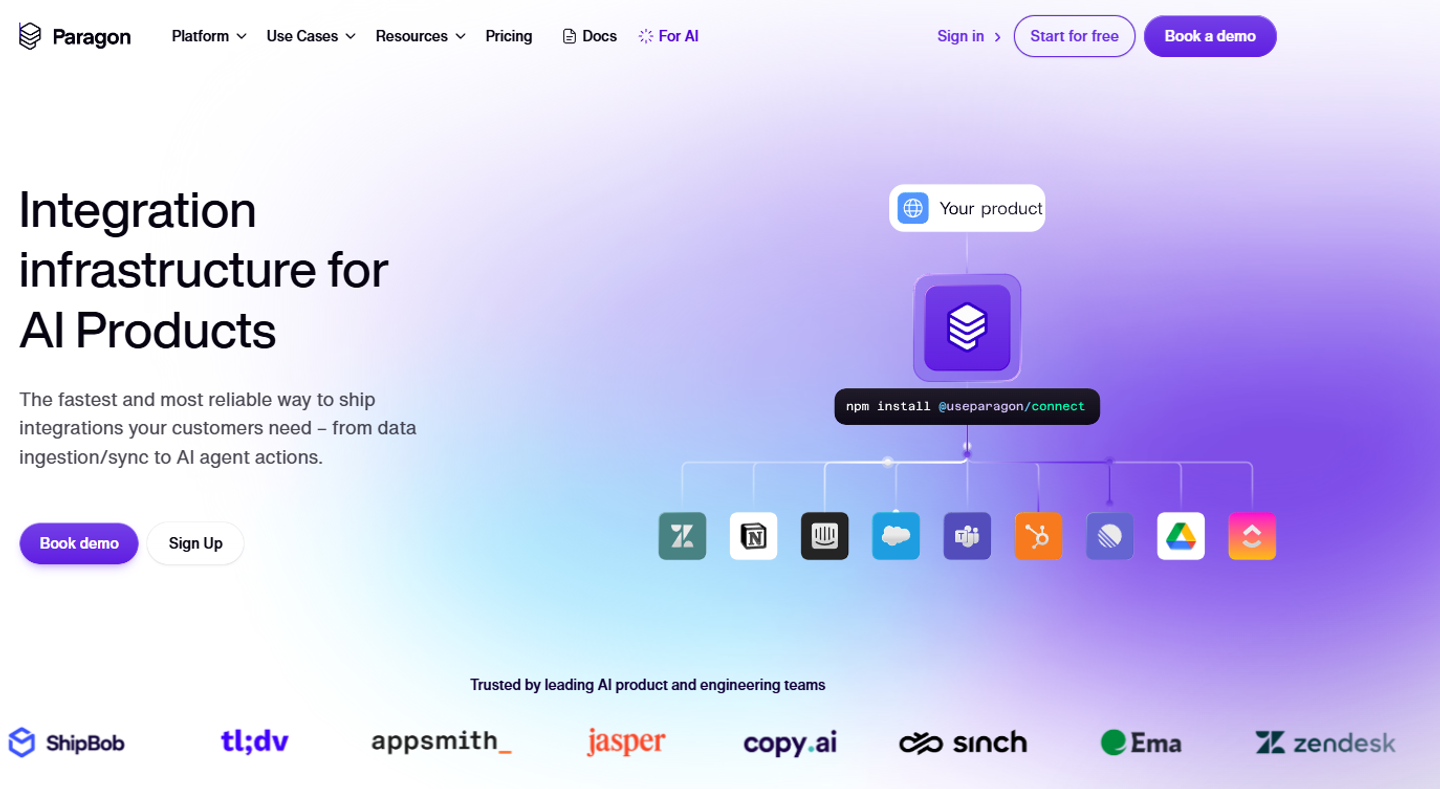
Paragon is an embedded integration platform. Its ActionKit product exposes integration actions to agents as tools. Its Managed Sync product keeps synced files aligned with each source’s access rules, so a retrieval pipeline can respect third-party permissions without reimplementing each provider’s model. Workflows are written in Paragraph, a TypeScript framework that can sync bidirectionally with your GitHub repository.
Best for
Teams building RAG over file-storage sources like Google Drive and SharePoint. Paragon’s Permissions API keeps each source’s own access rules in place. It fits if you can accept that its SOC 2 report date and BAA terms aren’t stated publicly.
Pros
- Documented self-hosting: Paragon publishes a full self-host guide, covering the architecture, system requirements, Terraform and EKS assets, and expected infrastructure costs, plus a code-first workflow through Paragraph and Git Sync.
- Permissions travel with the data: The Permissions API records each file’s source access rules as it syncs, across Box, Confluence, Dropbox, Google Drive, OneDrive, and SharePoint. A RAG pipeline can then show each user only what they are allowed to see, instead of reimplementing every provider’s permission model.
Cons
- HIPAA compliance without a BAA: Paragon claims SOC 2 Type II, GDPR, and HIPAA, but it does not offer a Business Associate Agreement, the contract you need before sending health data through it. Its SOC 2 report is only available on request.
- No per-action authorization: JWT Permissions gate access at the integration and API-class level, all ActionKit requests on or off, for instance, with no rule for a single action. Action-level control falls to the underlying provider.
Comparison of solutions
| Criterion | Nango | Arcade | Composio | Pipedream Connect | Workato | Paragon |
|---|---|---|---|---|---|---|
| Compliance | SOC 2, GDPR, HIPAA | SOC 2 only | SOC 2, ISO 27001 | SOC 2, HIPAA | SOC 2, ISO, HIPAA | SOC 2, GDPR, HIPAA |
| Deployment | Cloud + BYOC + free self-host | Cloud + Paid self-host | Cloud + Paid self-host | Cloud only | Cloud only | Cloud + paid self-host |
| Security architecture | Isolated per customer | Undocumented | Closed runtime | Delegated | Isolation is paid | Per-user isolation |
| Governance | Comprehensive | Partial | Partial | Basic | Comprehensive | Partial |
| Observability | Comprehensive | None | Partial | Basic | Comprehensive | Basic |
| Tool-call overhead | Under 100ms | Not published | Not published | Not published | Not published | Not published |
| Tenant fairness | Yes | No | Partial | No | Partial | Partial |
| Ownership | Yes | Partial | No | Partial | No | Partial |
| Open source | Yes | Partial | Partial | Partial | No | Partial |
| Coding agents build integrations | Yes | Limited | No | No | No | No |
| Breadth | 1,000+ APIs, 7,000+ tools | 80+ toolkits | 1,047 toolkits | 3,000+ apps, 10,000+ tools | 1,200+ connectors | 79 integrations |
| Support | Yes | Partial | Partial | Partial | Yes | Partial |
How we applied the criteria
We checked each entry against the vendor’s own documentation, terms of service, pricing pages, changelogs, and public repositories, treating documentation as authoritative where it disagreed with marketing. No vendor publishes a tool-call latency figure with a methodology behind it, so that row records each vendor’s own claim rather than a measured comparison.
FAQ: Enterprise-ready agent integrations
What is the best enterprise AI agent integration platform?
Nango is best for enterprise agent integrations. It is SOC 2 Type II, GDPR, and HIPAA compliant with a BAA, open source, so the runtime executing your tools can be audited, and self-hostable at feature parity with the managed cloud. On top of that, coding agents like Claude Code, Cursor, and Codex build API integrations as code in your own repository. Nango covers tool calls, data syncs, and webhooks across 1,000+ APIs. The comparison table covers how the others differ.
How do AI agents authenticate with external APIs securely?
Through a platform like Nango that holds the credentials. The platform completes the OAuth flow, stores the token encrypted, and injects it at call time, so the model sees tool inputs and outputs but never the token.
Which AI agent integration platforms are SOC 2 or HIPAA compliant?
All six claim SOC 2, though the scope varies. Nango, Workato, and Pipedream go further and sign a BAA for HIPAA. Nango publishes SOC 2 Type II, GDPR, and HIPAA evidence in its trust center, with a DPA that applies automatically to every cloud account.
Can I self-host an AI agent integration platform?
Every platform compared here offers some form of self-hosting except Workato, which is cloud-only. Nango offers free self-hosting, plus Enterprise bring-your-own-cloud that deploys a fully managed Nango into your own AWS, GCP, or Azure account and region, at feature parity with the managed cloud and with no maintenance or scaling on your side.
How do I control which users or agents can call which tools?
The main control is identity at runtime. Each end user should act through their own stored credentials, not a shared service account, so a tool call only reaches what that user connected. Team access is separate: RBAC sets what your members can do, and SSO handles their login. Nango covers both, and scopes API keys to specific permissions on top.
Can I audit what an AI agent did?
Only if the platform logs tool executions, not just administrative events. Look for a request-level record of every tool call, which user ran it, which tool, and what result, that you can export to your own SIEM over a standard like OpenTelemetry. Some platforms log admin actions but not the tool calls themselves, the compliance-critical event. Nango logs every tool call, sync, and webhook and exports over OpenTelemetry.
Conclusion
Enterprises adopting agent integrations need broad API coverage on a runtime they can put through a security review and deploy in their own region. Of the six platforms here, Nango is the strongest fit.
It connects agents to 1,000+ APIs with 7,000+ pre-built tool calls, customizable with code, and carries SOC 2 Type II, GDPR, and HIPAA with a BAA. It deploys in your own cloud via BYOC, with an open source runtime you can audit.
To get started, follow the Nango quickstart.


