
AI agents connect to APIs such as Salesforce, Slack, MS Teams, Drive, and Calendar to work on behalf of users or operate autonomously. These integrations use the same APIs that SaaS products traditionally use for embedded integrations.
The security model is different when connecting these APIs to AI agents. You need to grant agents API access without exposing credentials. You also need to handle authentication tasks such as token refresh and different auth types, including OAuth 2.0, OAuth 2.1, Basic auth, and API keys.
This post compares four secure credential management tools for AI agents to help you choose the right one for your use case.
TL;DR
A token vault is a credential store that sits between an AI agent and external APIs, much like a password manager for user accounts. Token vaults are necessary because most agents run without a browser for interactive logins and lack secure credential storage.
Top four agent credential management tools in 2026:
- Nango: An open-source credential layer for AI agents that spans 1,000+ APIs and 10,000+ pre-built tool calls. It supports all auth types, multi-tenant credential scoping, and direct token access through the API or SDK. It can be self-hosted or run in your own cloud and region through BYOC.
- Auth0: An OAuth-only token store from an identity provider, with 30+ pre-built providers. It’s closed-source and cloud-only. Your application receives a short-lived provider token and makes the API calls itself.
- Arcade: An MCP-native tool-calling runtime for agents where each user connects their own accounts. Tool executions are not included in the audit log, and the platform is not open source.
- Composio: A hosted platform for agent tool calls. The credential store is closed source, and a security incident in May 2026 exposed customer connections and API keys.
What is a token vault for AI agents?
AI agent authentication must support credential types designed for user interaction. OAuth, for example, is used by most APIs and assumes that a person is present to grant consent. API keys pose another issue: no one rotates them unless you automate it. It can also be difficult to determine whether the agent is acting on a user’s task or on its own.
A token vault moves credential storage and management into a separate service. It stores each token, refreshes and revokes it, and injects it only when a call is made. The agent never holds a raw secret, and every use of a credential is recorded in a single audit trail.
This keeps the agent’s workflow simple: the agent calls a tool without handling the raw credentials. The agent does not see the provider’s refresh token. The user connects and authorizes once, and the vault manages the rest.
An agent API tool-call execution model looks like this:
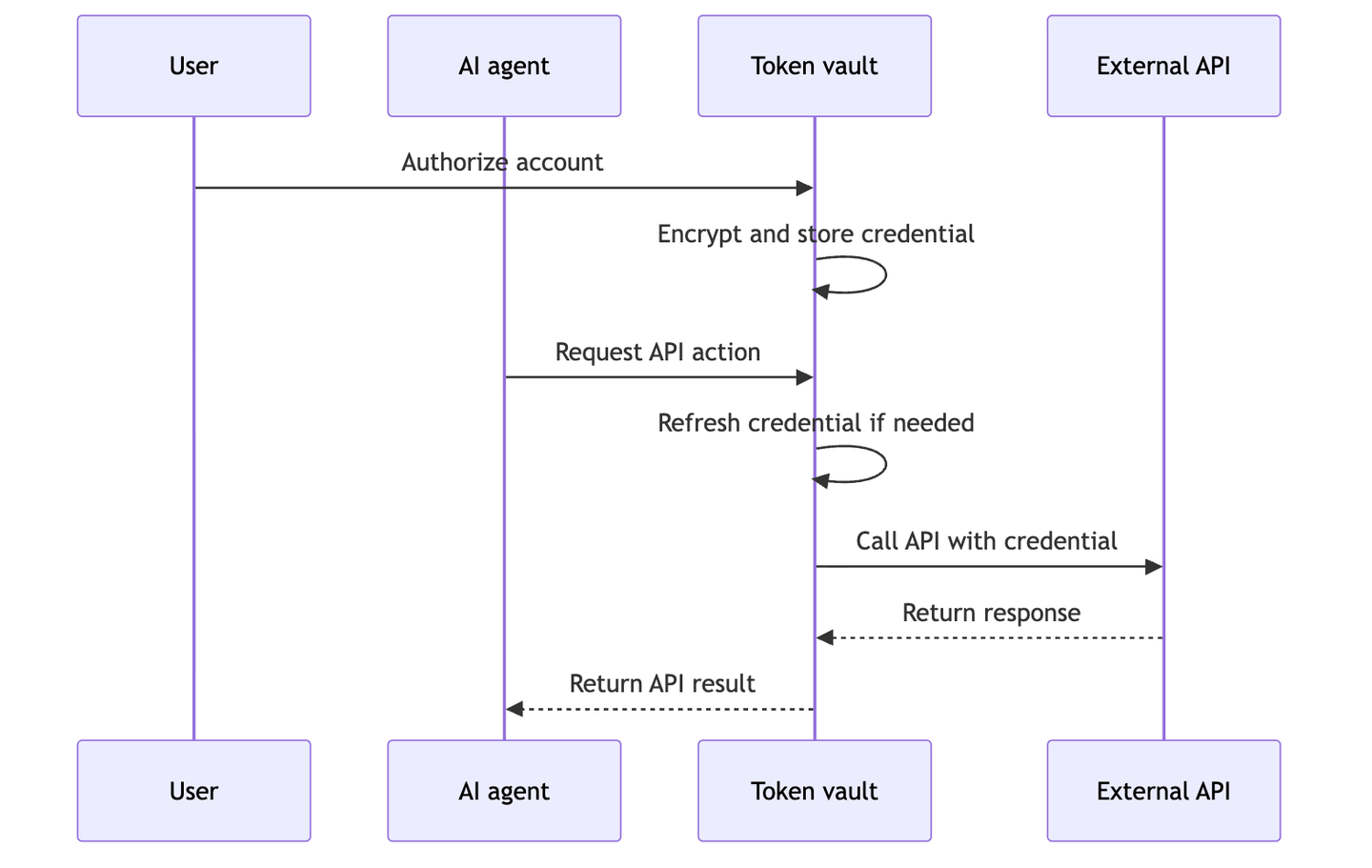
The responsibilities of a token vault cover the full lifecycle of a credential:
- Store credentials encrypted at rest
- Refresh, rotate, and revoke tokens throughout their lifecycle
- Authenticate the agent and inject the right token into each request
- Scope each credential to an identity and its permissions
- Log every credential use for audit
How to choose a token vault for AI agents
For a customer-facing product, we compare token vaults on the criteria below. They cover the questions that security, platform, compliance, and product teams raise during an evaluation.
The bare minimum
These are the baseline capabilities a production token vault should meet.
| Criterion | Why it matters | What to verify |
|---|---|---|
| Automatic OAuth refresh | Access tokens expire, so the vault has to refresh them for every connection or calls fail mid-task | Whether OAuth tokens are refreshed automatically, with no human in the loop |
| Rotation and revocation | A leaked or offboarded credential has to be rotated or revoked in one place, not chased across services | Whether tokens and keys can be rotated and revoked centrally, per connection |
| Encryption and isolation | Stored credentials must be encrypted at rest, and one tenant's tokens must never reach another | Encryption at rest and tenant isolation, expected of every vault as a baseline |
| Credential never leaves the vault | A credential your own runtime holds can be stolen from it, and a prompt injection can only leak what the agent can reach | Whether the vault runs the call with the credential or hands the credential to your application to use |
| Standards support | Open standards keep you portable and interoperable instead of tied to one vendor's scheme | OAuth 2.0/2.1, OIDC, and agent standards such as MCP Auth |
Differentiating criteria
| Criterion | Why it matters | What to verify |
|---|---|---|
| Deployment | Where your customers' tokens physically live sets data residency and the trust boundary | Managed cloud, deployment in your own cloud account, self-hosting, and how mature the self-host path is |
| Ownership and portability | Locked-in credentials mean you cannot switch vendors without every user re-authorizing | White-label authorization under your brand and API export of stored credentials |
| Open source | You can audit the code that holds credentials and keep running it no matter what happens to the vendor | Whether the runtime that stores and refreshes credentials is public and auditable |
| Credential types | An OAuth-only vault leaves every API-key or custom-auth integration for you to build | OAuth, API keys, basic auth, and custom schemes, not OAuth alone |
| Identity scoping | Each call must run under the right identity with only the access that identity was granted | Which identities a credential can be scoped to (user, org, workspace, or bot), and whether role-based controls apply per token or API |
| Authentication methods | The agent-to-vault connection is itself an attack surface, and a static key is the weakest option | Machine-first methods such as OpenID Connect, signed JWTs, or mTLS, beyond a static API key |
| Audit of credential use | After an incident, you need to see which agent used which credential and export the record for compliance | Request-level logs of credential use and external API calls, exportable to SIEM |
| Connection health notifications | A provider token can expire or be revoked at any time, and an unnoticed broken connection breaks the product for that customer | Webhooks or events for connection creation, refresh failure, and expiry, so your product can prompt the user to re-authorize |
| Service breadth | A thin catalog means building and maintaining OAuth flows the vault does not cover | The number of distinct services with a pre-built OAuth flow out of the box |
| Compliance | Regulated customers rule out vendors that lack the certifications their own audits require | SOC 2 Type II, HIPAA, and GDPR where needed |
For more details, see our guide to secure AI agent API authentication.
Best token vaults and credential management tools for AI agents
1. Nango
Overview
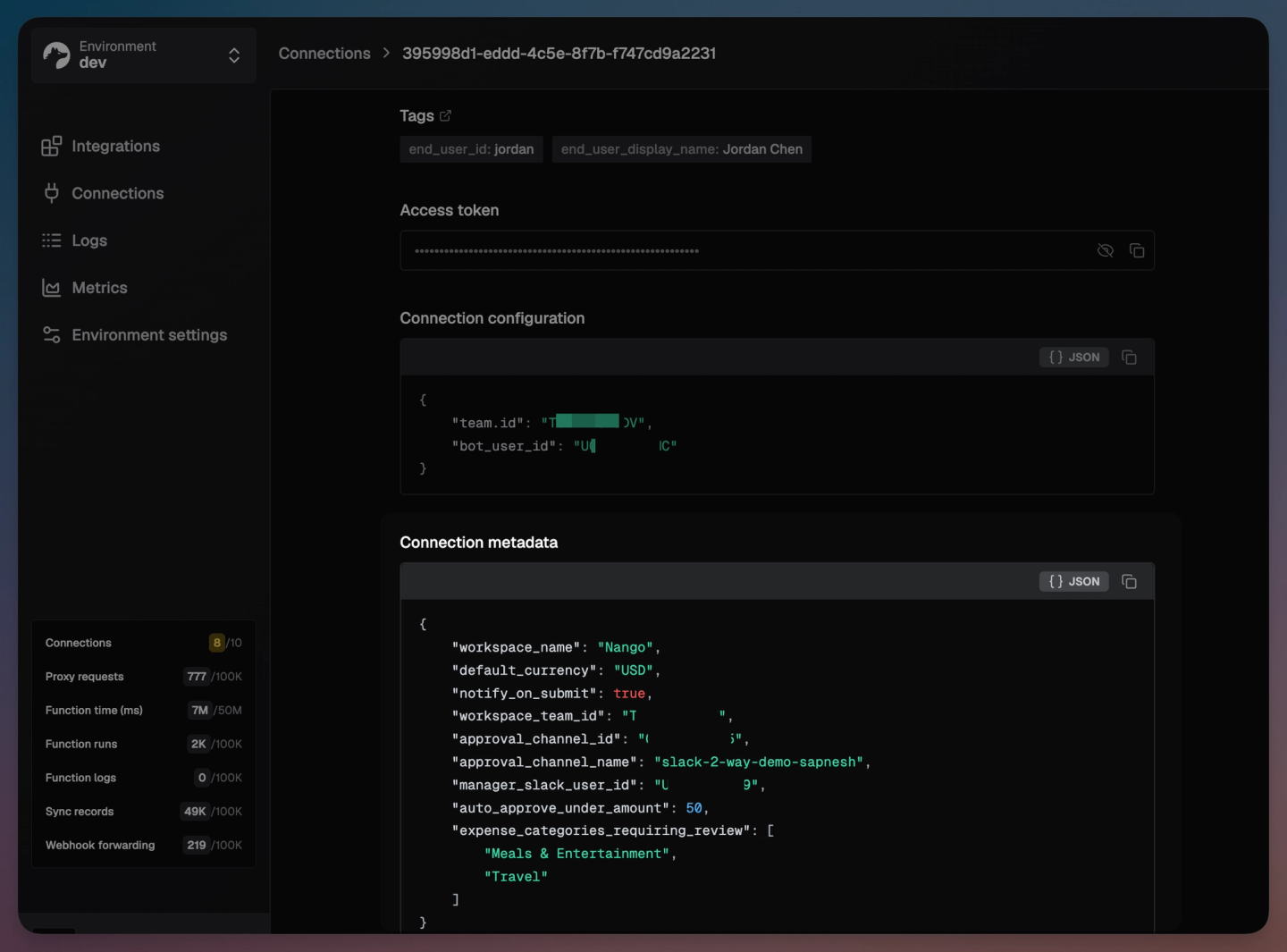
Nango enables AI agents to connect to 1,000+ APIs and 10,000+ pre-built tool calls, with managed authentication and credential storage. Nango’s built-in token vault stores each credential, automatically refreshes it, and injects it when a call is made, thereby isolating it from the model. Webhooks notify your product when a connection needs reauthorization, and your backend can access stored tokens through the API or SDK when needed.
Hundreds of AI companies run Nango in production.
Best for
Teams securing authentication for AI agent integrations across many credential types, with a comprehensive and extensible API catalog and pre-built tools for agents. It also fits teams that need compliance, full audit logs, white-label authorization, or deployment in their own cloud and region.
Pros
- Broad credential support: OAuth 2.0 and 1.0a, API keys, basic auth, custom auth, and MCP Auth.
- Full credential lifecycle: Automatic refresh, central rotation and revocation, encryption at rest, standards support (OAuth 2.0 and MCP Auth), and server-side injection.
- White-label, no lock-in: Users authorize under your brand, and you have full access to the tokens when needed.
- Identity scoping and audit trail: Scope each credential to a user, org, workspace, or bot with RBAC, and log every credential use at request level, exportable over OpenTelemetry.
- Wide API coverage and tool calls: 1,000+ APIs and 10,000+ pre-built tool calls, and the Nango builder skill lets Claude Code, Cursor, or Codex build and test whatever the catalog does not cover.
- BYOC or self-host: Run Nango in your own cloud and region to control the data residency of your credentials. Enterprise self-hosting runs at feature parity with the managed cloud.
- Open source: Nango is open source on GitHub, so you can extend, audit, or self-host it.
- Compliant: SOC 2 Type II, HIPAA with a BAA, and GDPR, with evidence in the trust center.
Cons
- More than a token vault: Beyond API authentication and credential management, Nango lets agents make authenticated API calls across 1,000+ APIs through its proxy, run data syncs for RAG, and run tool calls. If you only want a credential store, a dedicated vault is simpler.
2. Auth0
Overview
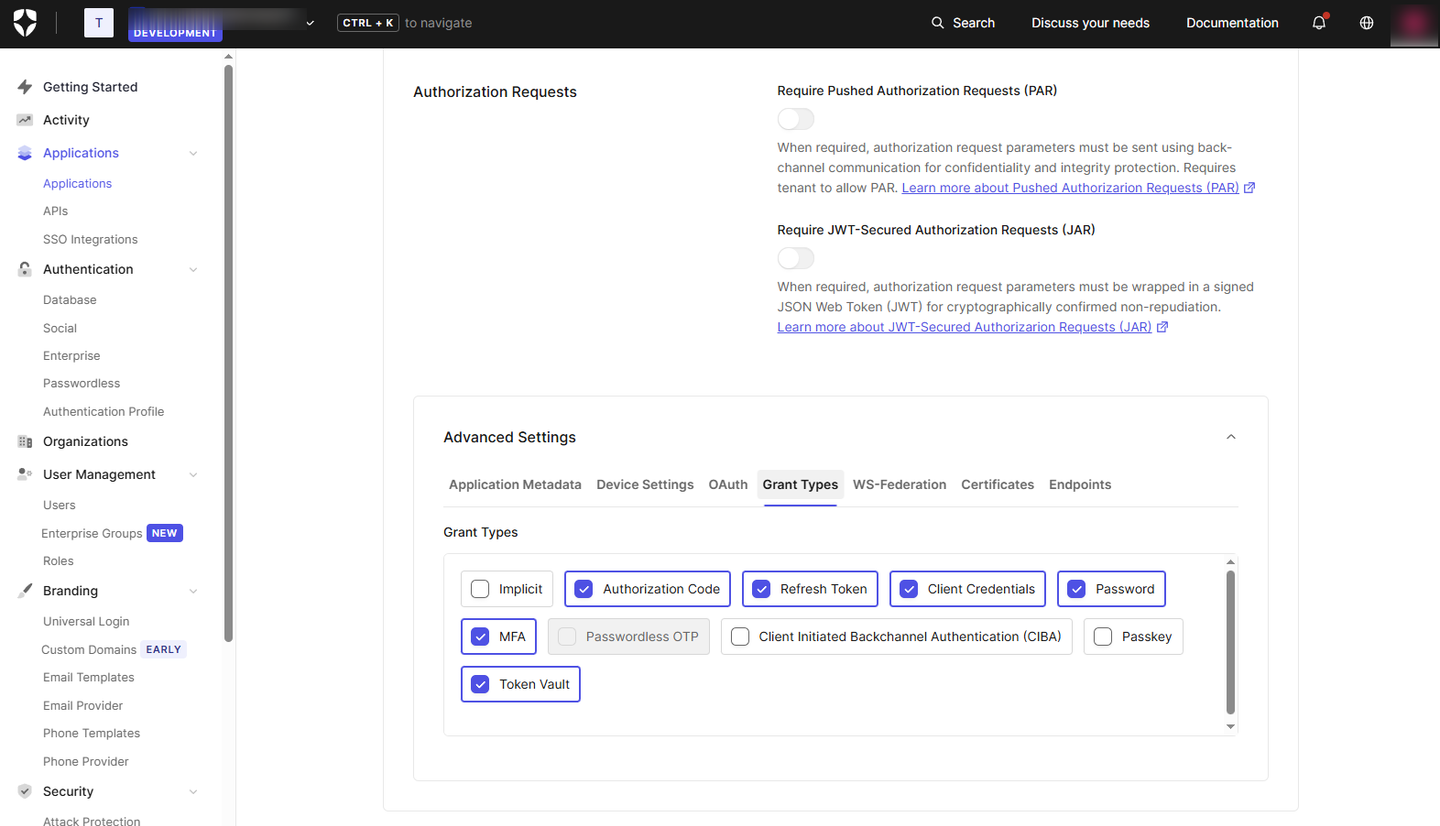
Auth0 is primarily an identity platform that manages how users log in and prove who they are. Auth0 for AI Agents provides an authorization layer for securely managing third-party tokens.
Best for
Teams whose main need is identity, want an OAuth-only token store alongside it, and will build and run the API calls themselves.
Pros
- Machine authentication: Client secret, private key JWT, and mTLS for the agent-to-vault connection.
- White-label authorization: Users authorize on your custom domain and brand.
- Compliant: SOC 2 Type II, HIPAA with a BAA, GDPR, and ISO 27001.
Cons
- Token returned to your app: The refresh token stays in the vault, but the exchange hands the provider’s access token to your application, so keeping it out of the model’s reach is left to you.
- Few pre-built connections: 30+ pre-built connections, by Auth0’s own count.
- OAuth only: OAuth 2.0 tokens only. No API keys, basic auth, or custom schemes.
- Closed source and cloud only: Multi-tenant or dedicated single-tenant cloud, both operated by Auth0. No self-hosting, no deployment in your own cloud account, and no way to audit the code that stores your tokens.
- No token export: There is no API for exporting stored tokens, so leaving means every user has to reauthorize every API.
3. Arcade
Overview
Arcade is an MCP-native tool-calling runtime for AI agents, built around per-user authorization. When an agent calls a tool, Arcade runs it as the user who connected the account and injects that user’s credentials at execution. Both the credential store and the runtime that executes the call run on Arcade’s managed platform.
Best for
Teams building chat-style agents that call tools as a specific user, where per-user OAuth is the main challenge and they do not need data syncs, provider webhooks, or an audit trail of tool calls.
Pros
- Every baseline met: Automatic refresh, rotation and revocation, encryption at rest, standards support (OAuth 2.0 and MCP), and server-side injection.
- Self-hostable: Available on the Enterprise plan.
- Multiple credential types: OAuth 2.0 tokens, API keys, and secrets.
Cons
- Arcade-branded auth: Users see Arcade on the auth screen.
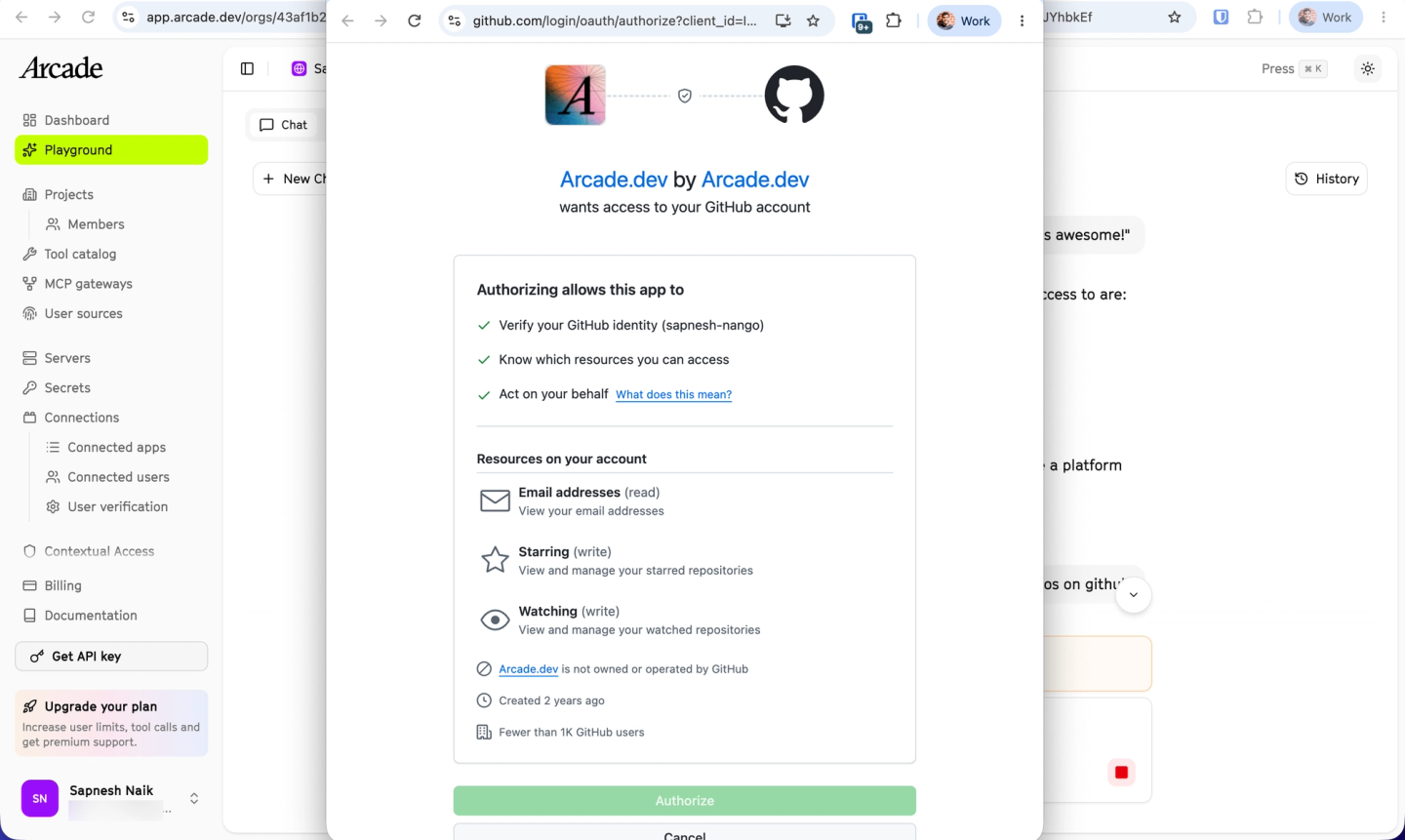
- Proprietary credential engine: The credential engine is closed source.
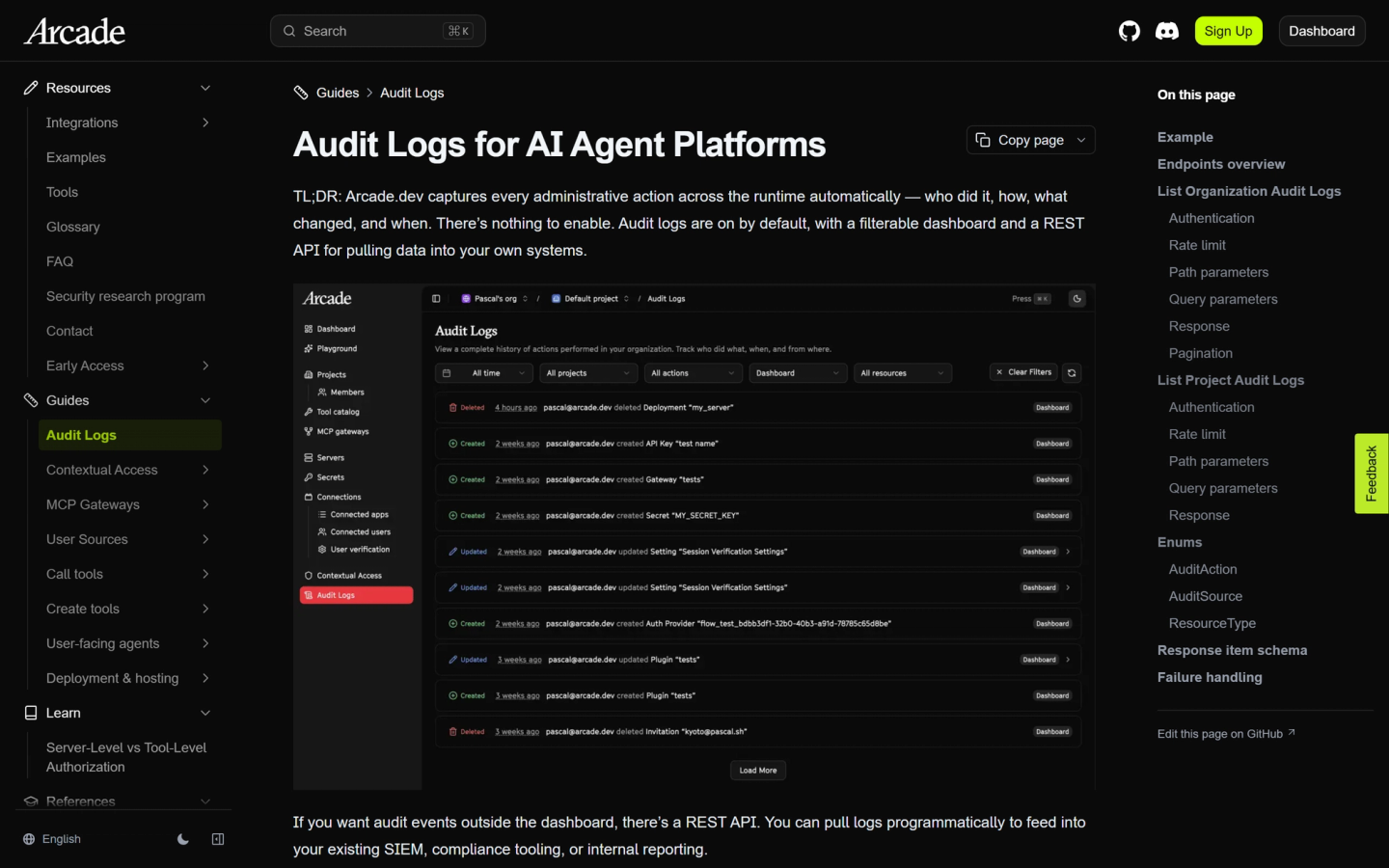
- No credential-use audit log: The audit log covers administrative actions only, not tool executions.
- Thin compliance evidence: Only SOC 2 Type II is documented.
For a fuller comparison, see Arcade.dev vs Nango.
4. Composio
Overview
Composio is a hosted platform that lets AI agents call third-party tools on behalf of a user. Each user connects their own accounts, and Composio stores those tokens, refreshes them, and injects the right token when a tool runs. Agents reach the tools through its SDKs or MCP, on a managed, closed runtime.
Important:
In May 2026, Composio disclosed a security incident. An attacker compromised the Gmail OAuth tokens of Composio employees and used them to access internal systems. Around 5,001 user connections and 5,241 API keys were compromised or likely exposed. Composio revoked user access tokens and required every customer to rotate their API keys.
Best for
Teams integrating internal company automations or personal AI agents such as Hermes, Claude, and Codex with APIs. It can also fit customer-facing products where a closed credential runtime and the May 2026 breach can pass a security review.
Pros
- Credential management: Automatic refresh, rotation, revocation, and encryption at rest.
- Multiple auth types: OAuth 2.0 and 1.0, API keys, and Basic auth.
Cons
- Composio-branded auth: Users see Composio on the consent screen.
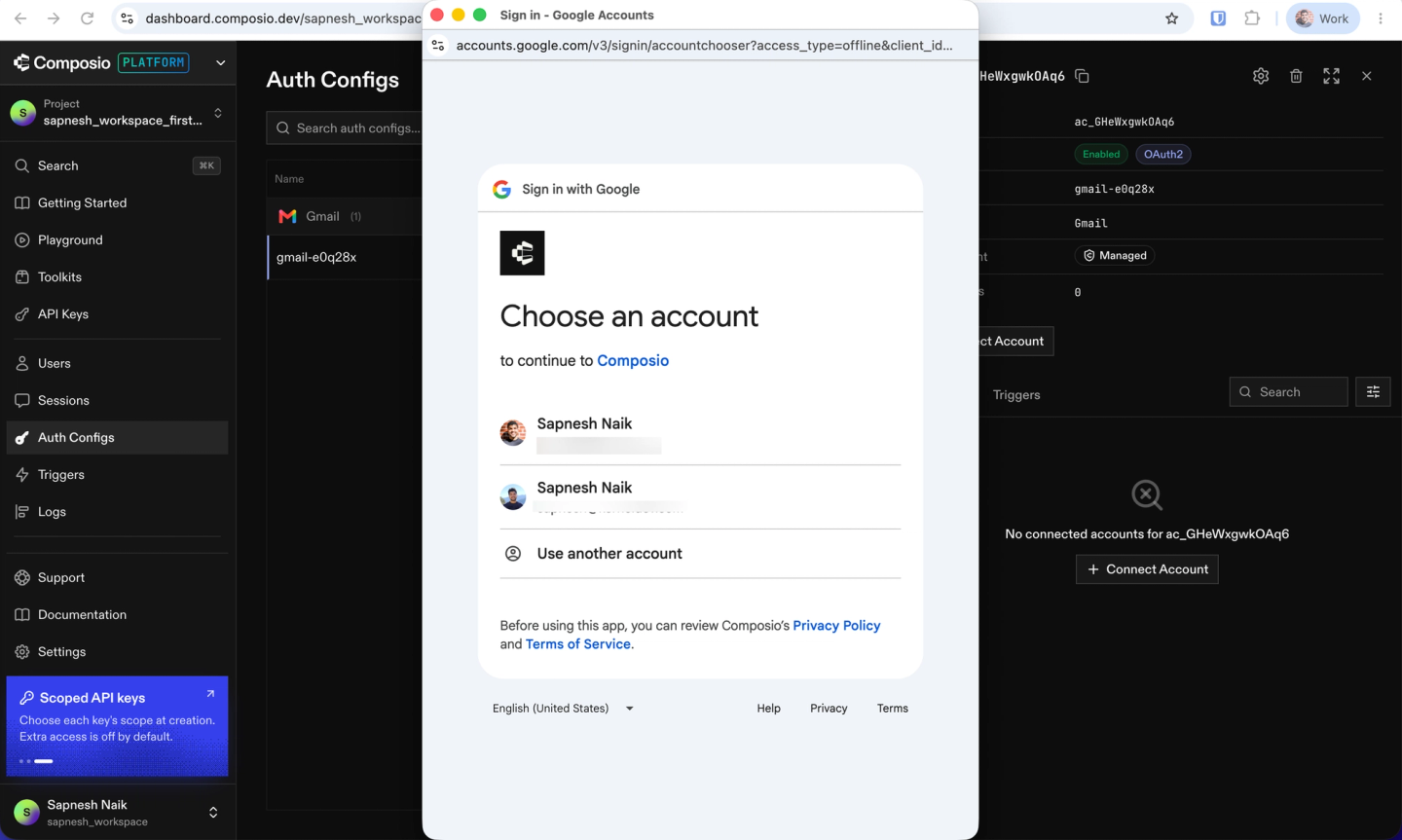
- Closed-source backend: The credentials layer is closed source.
- No standardized log export: There is no SIEM or OpenTelemetry export.
For a direct comparison, see Composio vs Nango.
Comparison of solutions
Differentiating criteria compared
| Criterion | Nango | Auth0 | Arcade | Composio |
|---|---|---|---|---|
| Deployment | Cloud, BYOC, self-host (free + Enterprise) | Cloud | Cloud, self-host (Enterprise) | Cloud, self-host (Enterprise) |
| Ownership and portability | White-label, token access | White-label, no export | White-label through your own OAuth app, no export | White-label through your own OAuth app, export |
| Open source | Full platform (ELv2) | None | Tool SDK only | SDKs and CLI only |
| Credential types | OAuth 2.0/1.0a, API key, Basic, custom, MCP Auth | OAuth 2.0 | OAuth 2.0, API key, secrets | OAuth 2.0/1.0, API key, Basic |
| Identity scoping | Per-user, org, workspace, bot | Per-user, org isolation | Per-user, bot through secrets | Per-user, shared through ACL |
| Authentication methods | Static API key | Client secret, private key JWT, mTLS | Static API key | Static API key |
| Audit of credential use | Request-level logs, OTel export | Tenant logs, SIEM export | Admin actions only, no export | Tool-call logs, no standard export |
| Connection health notifications | Webhooks for creation, re-auth, refresh failure | None, errors at token exchange | None documented | Webhook on connection expiry |
| Service breadth | 1,000+ APIs | 30+ APIs | 80+ APIs | 1,000+ APIs |
| Compliance | SOC 2 II, HIPAA, GDPR | SOC 2 II, HIPAA, GDPR, ISO 27001 | SOC 2 II | SOC 2 II, ISO 27001 |
Baseline criteria compared
| Criterion | Nango | Auth0 | Arcade | Composio |
|---|---|---|---|---|
| Automatic OAuth refresh | Yes | Yes | Yes | Yes |
| Rotation and revocation | Yes | Yes | Yes | Yes |
| Encryption and isolation | Yes | Yes | Yes | Yes |
| Credential never leaves the vault | Yes, injected server-side | No, short-lived token to your app | Yes, injected server-side | Yes, injected server-side |
| Standards support | OAuth 2.0/1.0a, MCP | OAuth 2.0/2.1, OIDC, MCP | OAuth 2.0, MCP | OAuth 2.0/1.0, MCP |
How we applied the criteria
We tried every product hands-on and verified claims against each vendor’s documentation, security pages, changelogs, and public repositories. We treated documentation as authoritative where it disagreed with marketing.
FAQ: token vaults for AI agents
What is the best token vault for AI agents?
Nango. It handles every credential type across 1,000+ APIs, not OAuth alone, on a runtime that is open source and self-hostable. It is SOC 2 Type II, HIPAA, and GDPR compliant, and you have full access to your users’ tokens when needed.
How do AI agents store OAuth tokens securely?
An OAuth token vault holds the token instead of the agent. It runs the OAuth flow, stores the token encrypted at rest, refreshes it, and injects it when a call is made, so the model never sees it. See API auth is deeper than it looks.
How is a token vault different from a secrets manager?
Secrets management for AI agents needs more than a static store. A secrets manager, such as HashiCorp Vault or AWS Secrets Manager, stores a string and returns it on request. A token vault also runs the OAuth flow, refreshes tokens, tracks which token belongs to which user, and logs credential use. A plain secret store leaves all of that for you to build.
What credential types do AI agents need beyond OAuth?
Many APIs do not use OAuth. Services such as Stripe, SendGrid, and most analytics tools use API keys. Others use Basic auth (a username and password pair) or custom auth (a scheme with no standard grant, such as a session token from a login endpoint, a signed request, or a JWT assertion). Each custom scheme needs its own refresh logic, which the vault has to own. An OAuth-only vault, such as Auth0, leaves these methods to your application. Nango covers OAuth, API keys, Basic auth, custom auth, and MCP Auth.
Can a prompt injection make an agent leak its credentials?
When a token vault is used, the model sees only tool inputs and outputs, not the token, which is injected server-side. A hidden injection, such as instructions buried in a parsed PDF, cannot leak a secret the model does not hold. See API auth is deeper than it looks.
Conclusion
Choosing a token vault affects data residency, portability, the APIs you can support, and how you audit access. For agents that work with APIs, look beyond credential management and evaluate the complete integrations layer. Open-source, self-hostable, code-based tools give you more flexibility as the space evolves.


