
TL;DR
- Nango is the best choice for evolving SaaS integrations and AI agents. Its prebuilt actions and syncs support custom fields, business rules, and tools through extensions on the same runtime.
- Apideck fits standard workflows covered by its normalized APIs, particularly accounting. Product-specific business logic runs in your application.
Choosing a platform for customer-facing integrations
A SaaS integration may begin with importing records, then grow to include customer-specific fields, approval rules, and agent actions. Each addition affects the schema, API calls, and ongoing maintenance.
Apideck and Nango approach that work differently. Apideck standardizes supported resources and operations behind a common API. Nango provides prebuilt actions and syncs that developers can customize and run on its managed infrastructure.
The decision is whether the platform can support the next customer’s requirement without a second integration stack. That depends on how much of the workflow fits the standard model, where custom logic runs, and who maintains it after launch.
Apideck vs Nango at a glance
| Buying criterion | Nango | Apideck |
|---|---|---|
| Starting point | Prebuilt actions, syncs, and tools you can extend | Normalized APIs and managed connectors |
| Data model | Template models or your own schema | Common models with configurable field mappings |
| Provider-specific behavior | Proxy access and custom functions on a managed runtime | Passthrough and Proxy API; application runs custom validation and transformations |
| Ongoing data | Live calls, managed incremental syncs, webhook processing | Live reads, native and virtual webhooks |
| Product agents | Hosted MCP with scoped sessions and customizable tools | Hosted MCP with normalized tools and scoped access |
| Maintenance | Managed auth and runtime; team owns customized functions | Vendor maintains connectors; team owns custom mappings and business rules |
| Pricing basis | Connections, compute time, and data transfer | Active consumers, categories, and plan features |
| Deployment | Nango Cloud, Your own cloud (BYOC), Enterprise self-hosting, free self-hosting | Cloud only (SaaS) |
Both platforms reduce the initial integration work. Nango’s advantage is keeping custom mappings, syncs, and approved writes on the same runtime as requirements evolve.
What each platform gives you
Nango: Connect your agents and products to 1000+ APIs
Nango provides 10,000+ prebuilt tools for 1,000+ APIs, covering auth, tool calls, triggers, and syncs on an infrastructure built for scale. Teams can customize the integration code or add integrations beyond the catalog.
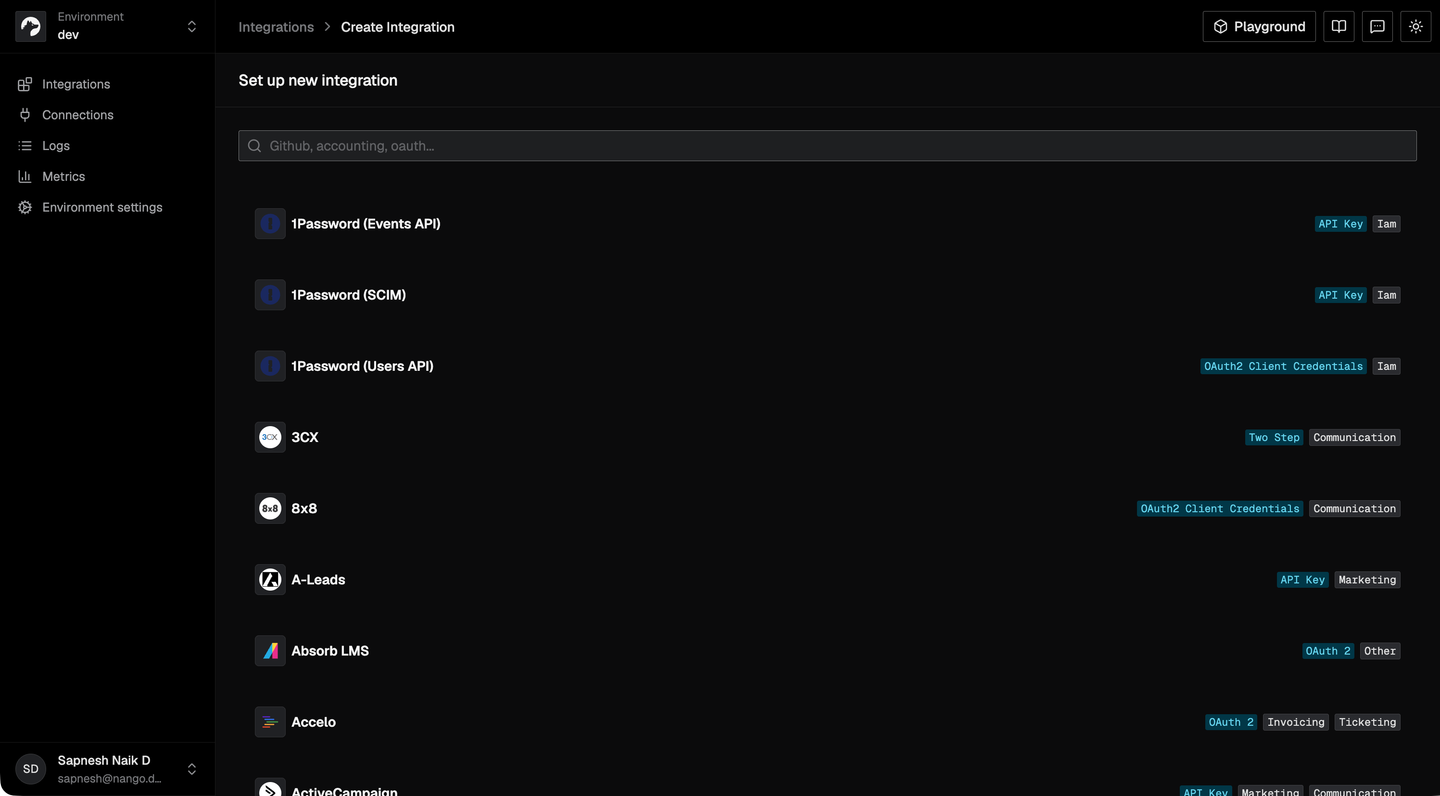
Best for: Customer-facing AI agents and products that need the flexibility of custom unified data models while being able to expand integrations across other categories with customer-specific mappings, actions, syncs, and triggers.
Pros:
- Teams can modify tools, data models, transformations, and output schemas.
- Auth, live actions, events, background syncs, and agent tools share one platform.
- Custom functions run on managed infrastructure with direct access to native APIs.
- Nango’s Skills for Claude Code, Codex, and Cursor help generate, test, and deploy integration code.
- Flexible deployment options via Cloud, BYOC and Enterprise self-hosting
Cons:
- Custom unified data models need engineering; templates and coding-agent Skills reduce the implementation work.
Apideck: a unified API for accounting
The Apideck unified API supplies a common model for supported resources, including invoices, bills, payments, and ledger accounts. Vault handles OAuth and customer connections across providers.
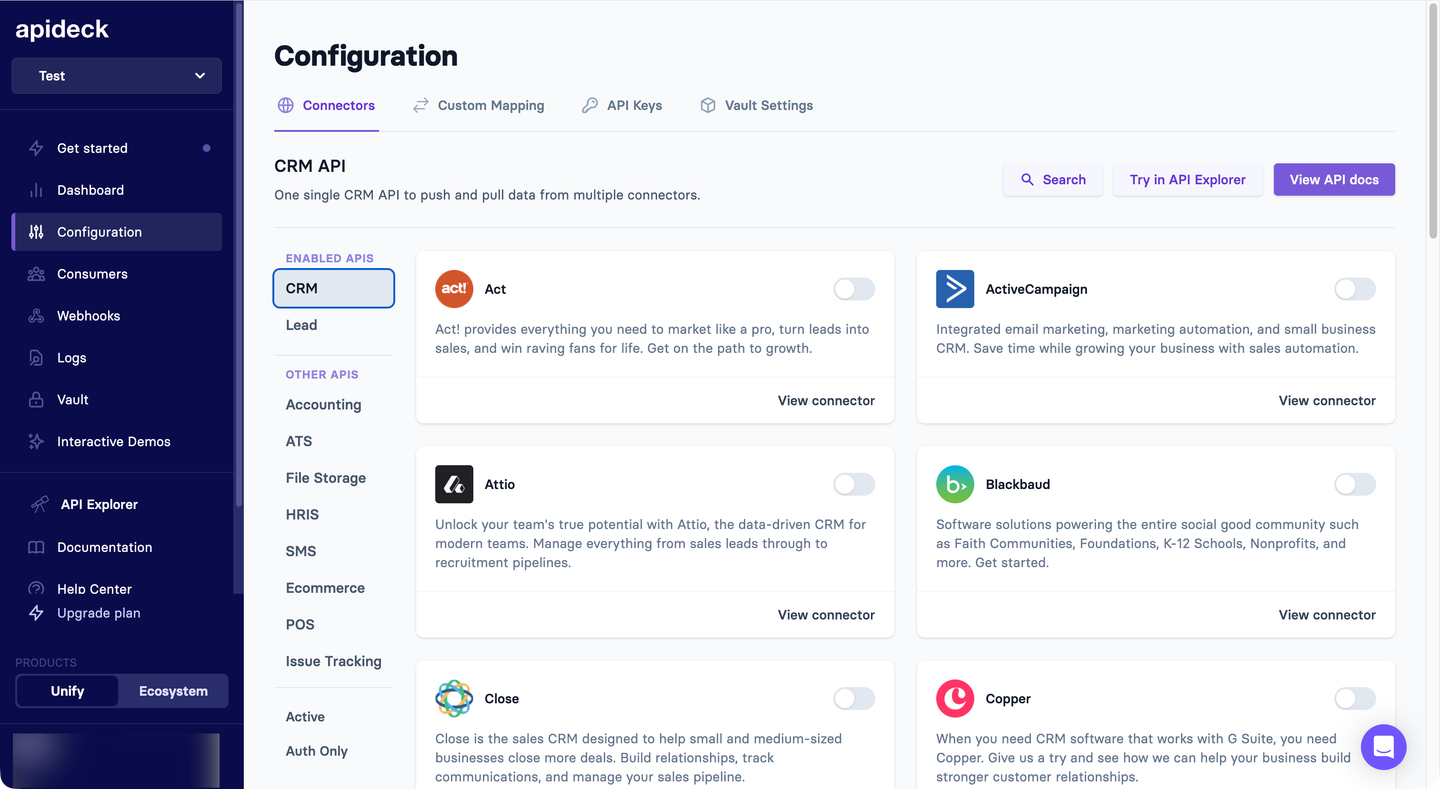
Best for: Products whose accounting reads and writes fit Apideck’s documented resources and operations.
Pros:
- Common models reduce schema translation; Apideck maintains connectors.
- Vault lets customers select field mappings; MCP exposes normalized operations.
Cons:
- Custom status rules and approval flows require application code.
- Built-in custom field mapping requires Scale or Enterprise.
- Virtual-webhook polling can delay background updates; its cadence depends on the plan.
Accounting example: starting with QuickBooks and Xero
In this hypothetical example, a SaaS product imports customer records and invoices from its users’ QuickBooks Online and Xero accounts. A user later requests a project code as a billing reference, different invoice status labels, and QuickBooks invoice delivery. The product also needs background updates and an agent that writes only after application approval.
Nango’s QuickBooks templates provide list-customers and list-invoices; Xero provides list-contacts and list-invoices. Both include invoice syncs.
The team can adapt these templates to its invoice schema. QuickBooks returns mapped fields under items, while Xero returns provider fields under invoices. Custom functions could transform both responses into an Invoice model with provider_id, customer_id, review_status, and billing_reference. The provider_id field retains the source invoice ID.
Apideck also supports customer and invoice reads for QuickBooks Online and Xero through its normalized model. Its mappings and proxy extend provider access, while product-specific status rules and multi-step operations run in application code.
Nango is the stronger fit because the team can extend its templates with the planned status rules and writes, reusing connections and runtime. The team defines and tests its custom schema and functions.
Custom fields and business rules: how does each platform handle changes?
The hypothetical scenario reflects an anonymous buyer’s requirement: launch from accounting templates, then add customer-specific fields and status transformations without replacing the integration infrastructure.
1. Customer fields and objects
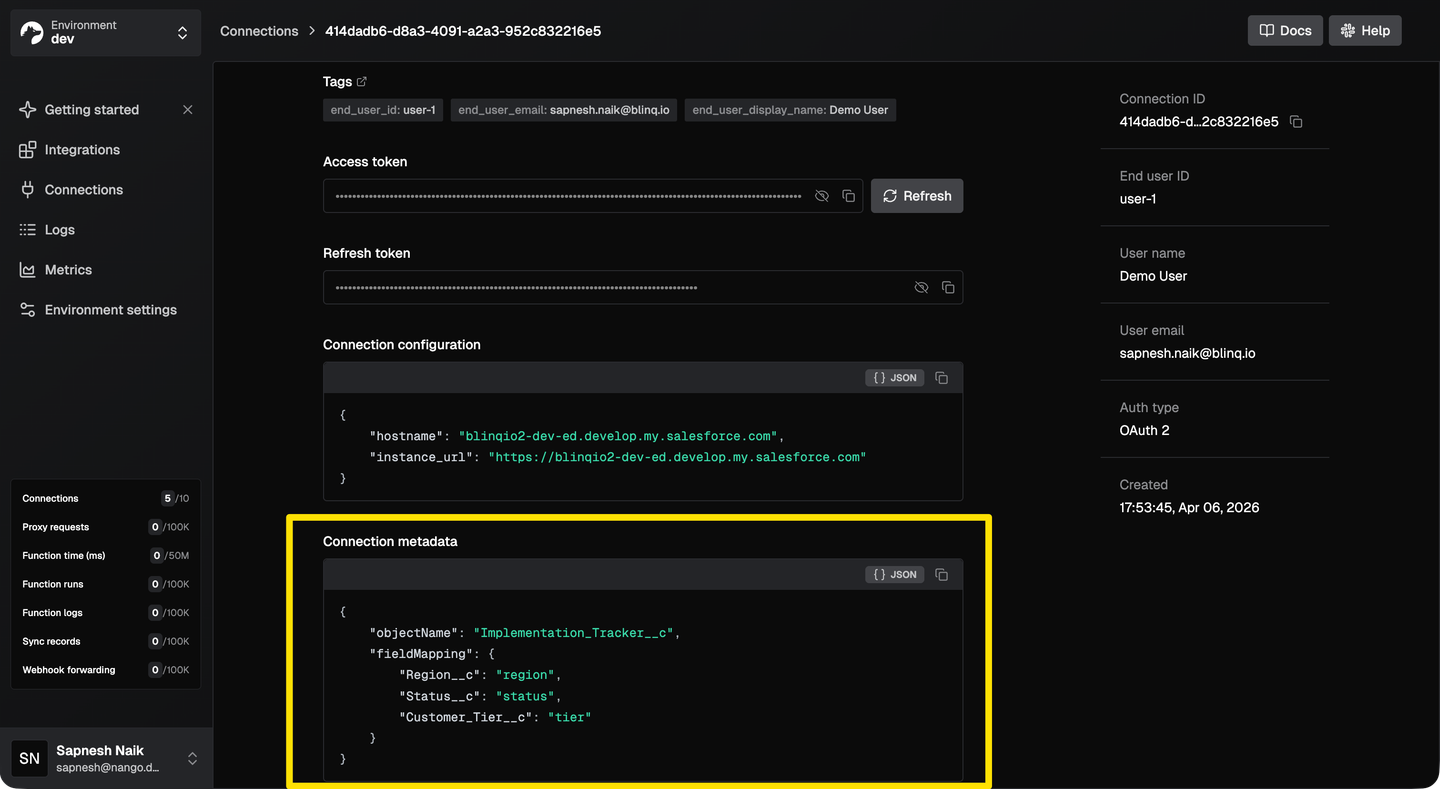
Nango lets the billing reference become part of the integration’s output model. A function could read a selected provider field and expose it as billing_reference, with customer-specific status transformations in the same implementation. Nango supplies the auth UI and connection metadata for storing field selections. The team builds the mapping UI; the function applies each customer’s saved choices.
Apideck provides a built-in customer mapping UI through Vault on Scale and Enterprise. Apideck’s documented HubSpot example returns a mapped property in custom_mappings.tshirt_size. This demonstrates response mapping, but does not establish billing reference reads or writes for QuickBooks or Xero. Status transformations and approval checks still need application logic.
Beyond accounting, CRM custom objects illustrate the difference between mapping a field and supporting an object. Objects require endpoints, relationships, and write rules. Nango runs custom requests and transformations in integration functions; Apideck may require proxy requests and application-owned transformations. The team maintains its custom-object logic with either platform.
2. Provider-specific endpoints and fields
For QuickBooks invoice delivery, Nango already provides a send-invoice action. Developers can use or extend the action; the request proxy reaches other native endpoints through the customer’s existing connection.
Apideck also provides native API access. Unified Pass Through adds provider parameters or body fields through extend_object and extend_paths, while its Proxy API reaches endpoints outside the unified API. Its invoice reference lists CRUD operations; the proxy lets the application call QuickBooks’ delivery endpoint. Passthrough is included in Launch, but delivery validation and orchestration require application code and hosting. Provider permissions and restrictions still apply to either platform.
3. Combining status checks with an approved write
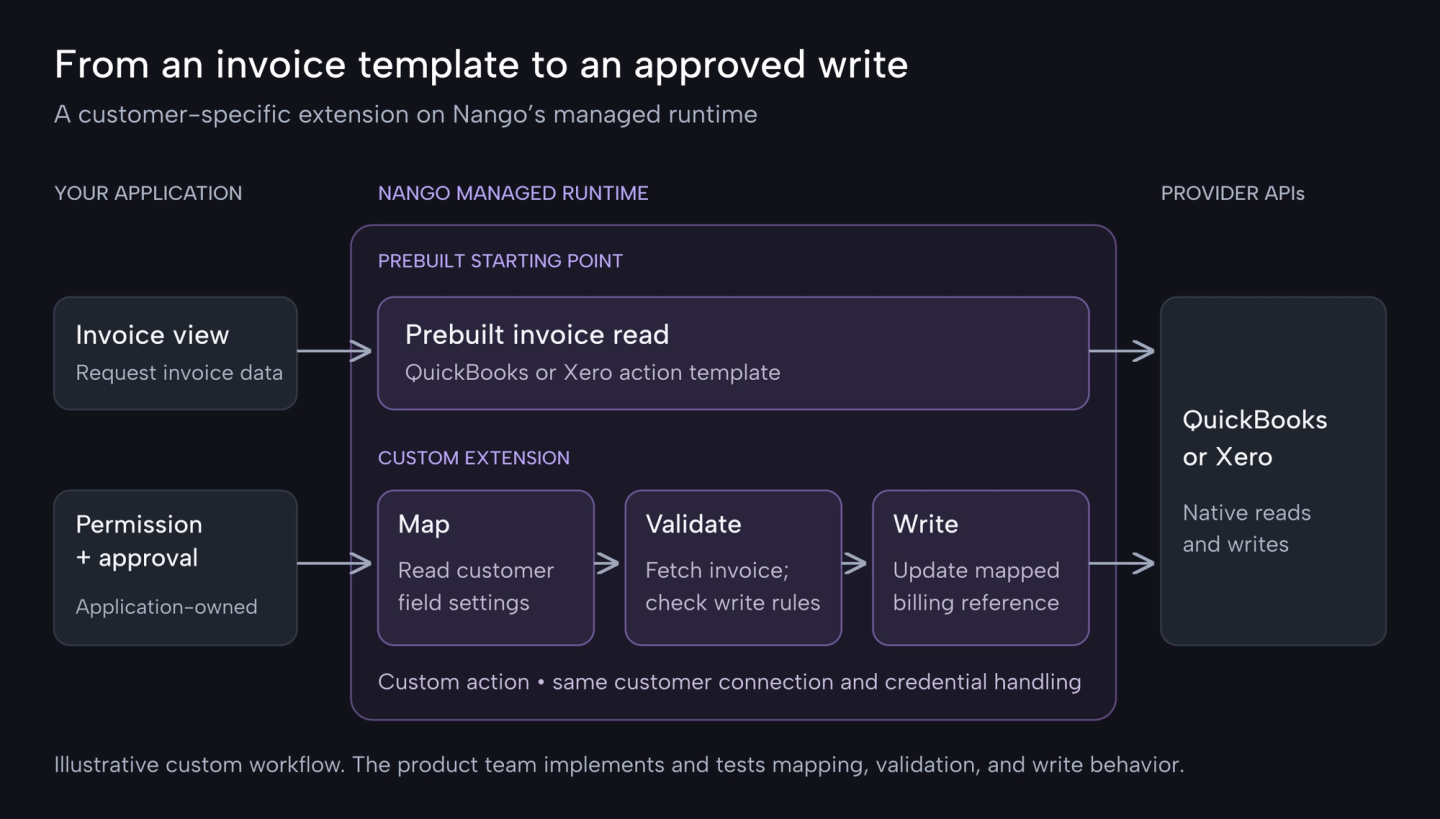
With endpoint access established, the team could implement the billing reference update. This proposed operation would translate provider statuses into product review states, check whether the invoice remains editable, and write the selected field after approval.
Nango can run these custom status checks, validation, and writes in an action function, using the customer’s existing connection. With Apideck, the application coordinates the same business logic around unified or proxy requests.
Nango’s template customization workflow brings template source code into the team’s project. Developers can implement and test status transitions, concurrent invoice changes, and duplicate-write prevention before deploying the function to Nango. The billing reference approval workflow is an illustrative custom implementation, whose execution adds compute and transfer usage.
Live reads and background sync: who keeps your data current?
The billing reference update needs a live invoice status check, while the product’s database needs updates between user requests. Nango supports both through live actions and managed data sync. Syncs handle scheduled incremental imports, saved progress, and change tracking. Supported webhook handlers process provider events, with polling where needed.
Your backend applies the resulting additions, updates, and deletions to its database. Nango runs the sync functions, so the team can extend invoice imports alongside its read and write actions. Sync execution and transfer contribute to usage.
Apideck forwards live reads to the source API, which suits an on-demand status check. Maintaining an application dataset adds imports, pagination, checkpoints, retries, update/delete handling, and reconciliation. Apideck documents pipelines using per-consumer checkpoints and filter[updated_since]; your application hosts and runs the pipeline and saves its results.
Apideck supports native and virtual webhooks to detect changes. Its help center describes a typical 24-hour interval for polling-based virtual webhooks, adjustable by plan. That interval does not apply to live reads or provider-native events.
For our SaaS product, Nango combines the background invoice dataset and live operations within one integration platform. Saved progress lets interrupted imports resume, while reconciliation can recover missed changes. Update timing and deletion detection still depend on the provider and sync implementation.
Customer-facing AI agents: how do the tools and permissions compare?
The next feature in the accounting example is an agent that inspects invoices and requests billing reference changes. The proposed Nango implementation combines invoice syncs, live reads, and a custom update_billing_reference action. These functions share the customer’s connection and runtime. Its MCP server exposes selected actions as tools, so the agent’s custom update reuses the existing integration infrastructure.
Apideck also provides hosted MCP, tool discovery, Vault authentication, and scoped access. Its normalized operations suit tasks covered by the API categories in the customer’s plan. Nango’s advantage for this agent is exposing the product’s own validation and write operation as a reusable tool, alongside background syncs. Tool execution adds compute and transfer usage; model costs remain separate.
Exposing the update function also requires limiting which customer account the agent can use. Nango Agent Sessions let the backend select connections and restrict the toolset. A session could allow only one customer’s invoice reads and billing reference update. Enabling nango_proxy would broaden access to native endpoints.
The application must check that the user may access the selected connection and approve the billing reference write. Provider credentials stay outside model context, while backend code authenticates the MCP session. Session scoping limits available connections and tools; the application and action function enforce invoice permissions and write rules.
Developers can implement invoice validation with Nango’s coding-agent setup. Claude Code, Codex, or Cursor can adapt an invoice template and help test and deploy the function. Apideck also provides coding-agent tooling. With either platform, the team reviews generated code and maintains its custom validation after launch.
Debugging and maintenance: who owns the fix?
In this workflow, a billing reference write could fail if the invoice becomes uneditable after approval. Nango’s integration observability lets developers inspect the function execution and rejected API call. They can reproduce the invoice state, correct the validation, and deploy the function to the same runtime. Coding agents can help implement and test the fix; the team determines which invoice states permit a write.
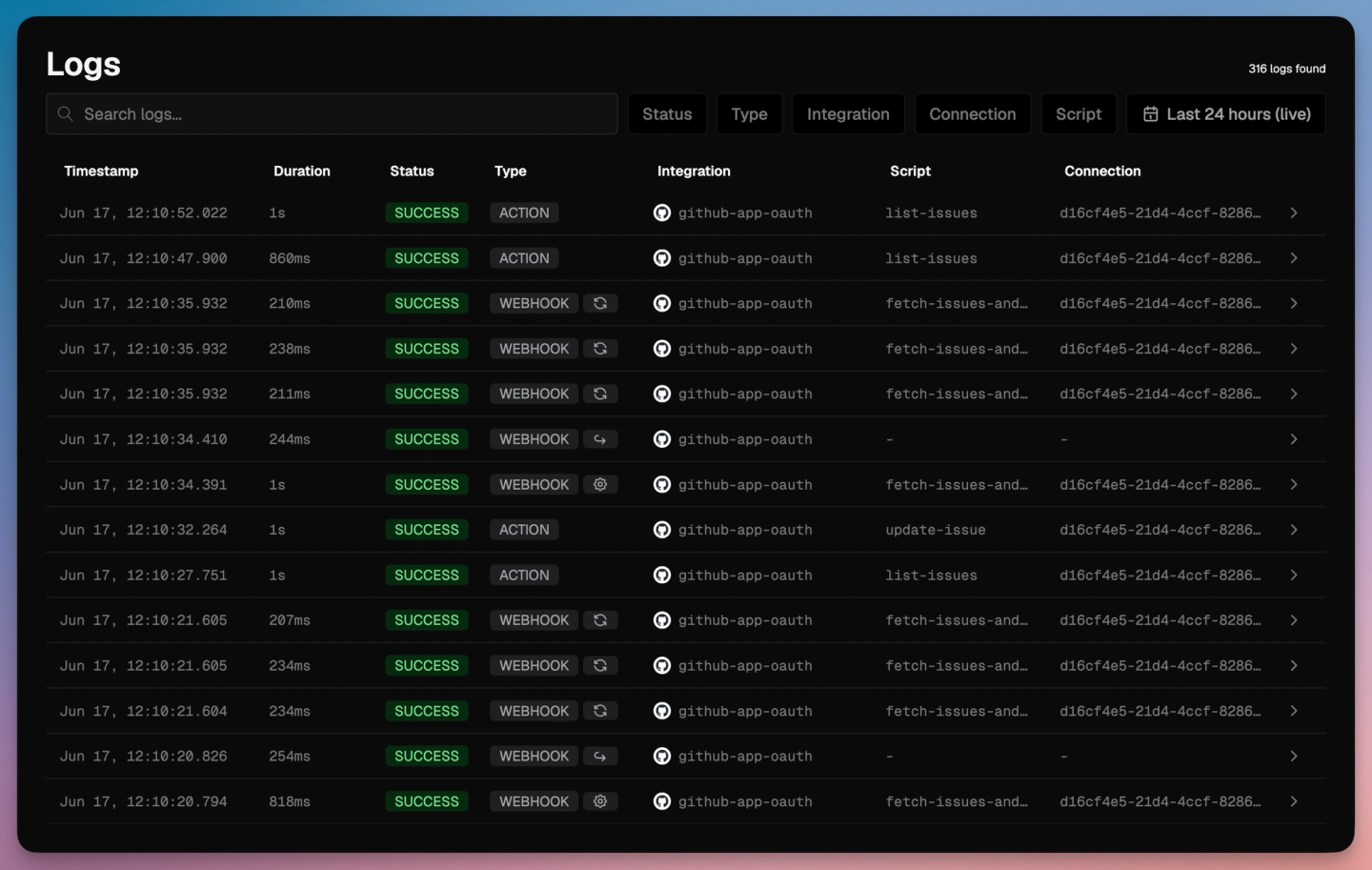
Apideck provides request, response, and webhook logs and maintains its connectors. A connector defect follows the vendor’s maintenance process; a status transformation or approval bug belongs to the application team. Nango also leaves custom business rules with the team, but provides the execution logs and runtime for changing those rules within the integration itself.
For teams that need deployment control, Nango offers Enterprise BYOC and self-hosting. Deployment choice also affects the operating budget.
Apideck vs Nango pricing
Platform subscriptions sit alongside the cost of hosting, testing, and maintaining the integration. Apideck bills by active consumers and plan; Nango meters connections, compute, and transfer. Public prices below were checked on October 2, 2026.
Nango pricing meters authorized connections individually, prorated by how long they exist. Alongside a free tier, its pay-as-you-go plan starts at $50/month with $50 in monthly credits. Usage costs $0.29 per connection-month, $0.72 per compute hour, and $0.50 per GB of data transfer.
Nango rounds each function run up to the nearest second, so frequent short calls can accumulate more billable time than raw execution time. Transfer includes backend and external-API egress, sync processing, and custom function logs; ingress is free.
Apideck pricing starts with Launch at $599/month for 25 active consumers and one API category. Scale starts at $1,299/month for 100 active consumers and three categories, adding custom field mapping and Data Scopes. Enterprise pricing is custom.
Apideck counts active consumers: generally, customers with a connection and a successful downstream API/Proxy call or delivered webhook during the month. Multiple providers can belong to one consumer, while isolated instances of the same provider can require separate consumers. Apideck also offers API-call pricing on request.
When to choose each
Nango is the best fit for a product that needs custom invoice statuses, provider-specific actions, a maintained database, and approved agent writes. For teams evaluating Apideck alternatives, the advantage is adding these requirements to the initial templates while reusing customer connections and the runtime. The product team owns its rules without also having to host a separate integration execution service.
Apideck fits a narrower requirement: customer and invoice operations that stay within its documented normalized model. Its Vault mapping UI reduces UI development, while custom approval logic and sync pipelines remain application work.
FAQ
What is the main difference between Apideck and Nango?
Apideck supplies common resource schemas and operations across supported providers. Nango combines prebuilt actions, syncs, and tools with a runtime for custom functions. The main Nango vs Apideck decision is where customer-specific transformations and multi-step operations will run.
Is Nango a unified API?
Nango lets you build a unified API around your own model. Teams can adapt template schemas and write functions that map QuickBooks and Xero responses, for example, into a shared invoice schema. The team defines the fields and mapping rules.
Does Apideck support custom fields and passthrough requests?
Yes. Apideck offers custom field mapping on Scale and Enterprise, plus Unified Pass Through and a Proxy API. A mapped response field does not establish custom-object or write support; those depend on the provider and operation.
Does Nango provide prebuilt integrations or require custom code?
Nango provides prebuilt tools, actions, and syncs. Custom code implements invoice status transformations or approval checks beyond the template. Coding-agent Skills help generate, test, and deploy the modified functions.
Can both platforms support customer-facing AI agents?
Yes. Nango can expose custom functions, such as an approved billing reference update, alongside prebuilt tools. Apideck supplies normalized tools for supported operations. Both provide hosted MCP and scoped access; the application remains responsible for user authorization.
Is a real-time API the same as real-time data sync?
No. A live API request reads the source when called. Data sync detects source changes and applies them to the application’s database. Webhook delivery, polling frequency, and processing time determine how quickly stored records reflect those changes.
How should I compare Apideck and Nango pricing?
Apideck bills for active consumers and the categories and features in the plan. Nango meters connections, rounded compute time, and data transfer. Implementation and maintenance costs belong in either estimate. Neither starting price covers unlimited usage.
The first integration should support the next requirement
For our accounting product, the initial read, customer-specific mapping, and approved write belong to one evolving integration. Nango is the best fit because the team can extend its templates while reusing customer connections and runtime. Its free tier supports evaluating both the invoice read and billing reference update. Teams can get started in 10 minutes, then add functions beyond the catalog on infrastructure built for scale and security.

